

Don Garlits and Darrell Gwynn; their lives in words and photos in new books

Random ramblings and rumblings, the sequel
Random ramblings and rumblings
Memories of Englishtown
Remembering Steve Ambrose
-
Right back where we started from: Winternationals is back at No. 1
Meet Larry Wood: The man whose designs launched a million hot rod dreams
Can you imagine a toymaker designing your Top Fueler? 'Snake' and 'Mongoose' could
For the love of old drag racing photos
The ultimate Funny Car winners quiz
Still popular after all these years: Catching up with fan favorites Eddie and Ercie Hill
Eddie Hill, the early years
55 years ago, Don Garlits forever changed the look, feel, and future of Top Fuel racing
On a roll: A look at some all-time great NHRA Drag Racing success streaks
NHRA's Top 75 Moments: Bernstein, 'Big,' and Shirley reflect on making history
- ad
Funny Car set to turn 1,000: A look back at the milestone races along the way
Beyond the Top 75s ...
Wait ... Jim Head was in a 1960s surf band promoted by a drag racing legend? Yep.
More Martin memories
The Popular Hot Rodding Championships put U.S. 131 in the national spotlight
Friends we lost in 2025
Re-telling NHRA history: The 75th anniversary book and other special projects
It was John Force's world, and we were all thrilled to be living in it
The Joyce of Drag Racing Photography
Two legends: 'Big' and Bakersfield
- ad
When did we start doing that? Tracking some of the biggest changes in our sport
From 10-time dominators to one-time winners, a history of Indy Top Fuel champs
Legend to legend: Don Prudhomme on Don Garlits, Indy, and other great takes
NHRA Rookies of the Year: A look back at where some fabulous careers began
NHRA national event history: A look at the tracks and stories that drove the sport
Random ramblings and rumblings
It’s been a blur of a NHRA 75th Anniversary season, a whirlwind of activity that is the culmination of plans laid more than two years ago. Indy is just around the corner, and before we know it, we’ll be crowning world champions in Pomona again.
Before we head into the NHRA U.S. Nationals and the madness of the Countdown to the Championship that follows, I wanted to download my observations and share some funny/cool things that have come up over the last eight months. It’s not a column about anything specific, but a random assortment of notes you might still enjoy.
I’m mighty proud of our publications team, which this year unveiled a 75th anniversary website that’s packed with history, stats, photos, videos, and more. It’s also the master home of the Top 75 Drivers and Top 75 Moments listings, two major tentpole programs of the 75th celebration. It took me about a year to pull together all of the elements and former NHRA.com webmaster Brent Friar to pull it all together for us. If you’re a history buff (and you probably wouldn’t be here if you weren’t), you should check it out.
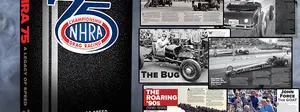
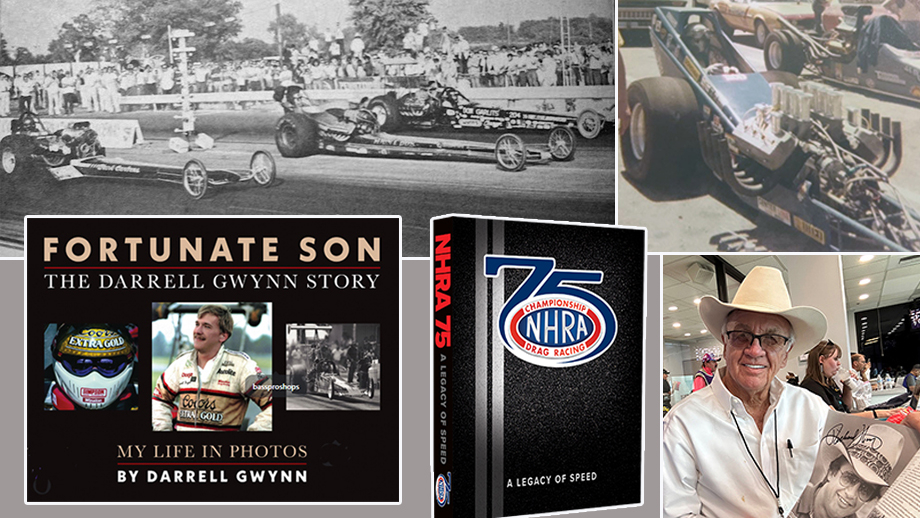
The other major projects were a pair of books, a 206-page coffee-table-style book on the history of the NHRA and a soft-cover book saluting the Top 75 Drivers.

The big book, NHRA 75: A Legacy of Speed, has sold like gangbusters, and we’re all very proud and pleased with that fact. We just completed the fourth and final printing of the book. From this point on, availability will be limited, and once they’re gone, they’re gone.
You can find out more about the books, including where to buy them, here.
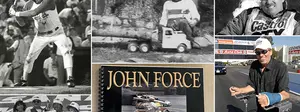
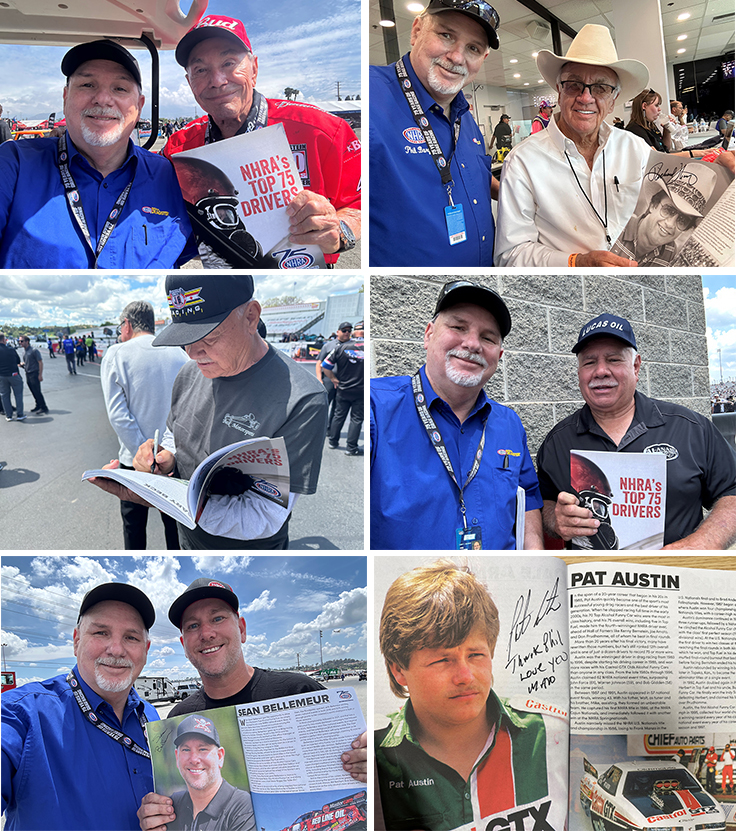
I pre-ordered several dozen of the Top 75 Drivers books to personally hand out to those drivers as they’ve been celebrated this year at various national events, brought to the starting line to accept their diamond awards, and introduced to appreciative crowds.
In exchange for the free book, I asked each for a selfie and to autograph my copy as a keepsake, much in the way I got the Top 10 of the original Top 50 Drivers to sign a hero card that NHRA created. Below are just some of them, including Kenny Bernstein, Richard Tharp, Gary Beck, Frank Manzo, Sean Bellemeur, and Pat Austin.
In addition to the Top 75 Drivers, we’ve also been saluting the Top 50 Sportsman Racers and Top 25 Alcohol Drivers with their own special keepsake, and several of them have been honored in two of the categories.
Top 75 Drivers/Top 50 Sportsman Racers: Peter Biondo, Jeg Coughlin Jr., Dan Fletcher, Shawn Langdon, Edmond Richardson, Scotty Richardson, and Jeff Taylor.
Top 75 Drivers/Top 25 Alcohol Drivers: Dale Armstrong, Brad Anderson, Pat Austin, Sean Bellemeur, Blaine Johnson, and Frank Manzo.

Through the ravages of time, 19 of the original Top 50 are no longer alive (some had even passed prior to their installation in 2001), but we’re still trying to salute as many as we can. I’ve been burning up the phone gathering contacts for family members.
Billy Glidden will be in Indy to allow us to celebrate his famed father, Bob, Kim LaHaie will be accepting for her father, Dick, at U.S. 131 Motorsports Park in September at a venue her father knew well, and David Reher will be at the Texas Motorplex to accept on behalf of Lee Shepherd and the four-time world champ Reher-Morrison-Shepherd Pro Stock team. Reher, by the way, is still making horsepower all these years later, keeping alive the Reher-Morrison engine-building business that he and Buddy launched in 1971.
Don “the Snake” Prudhomme, still very much alive and active, was kind enough to supply me with contact information for the families of two of his all-time friends, Raymond Beadle and Tom McEwen. I think it’s cool as hell that “Snake” stays in touch with the kids of his longtime buddies.
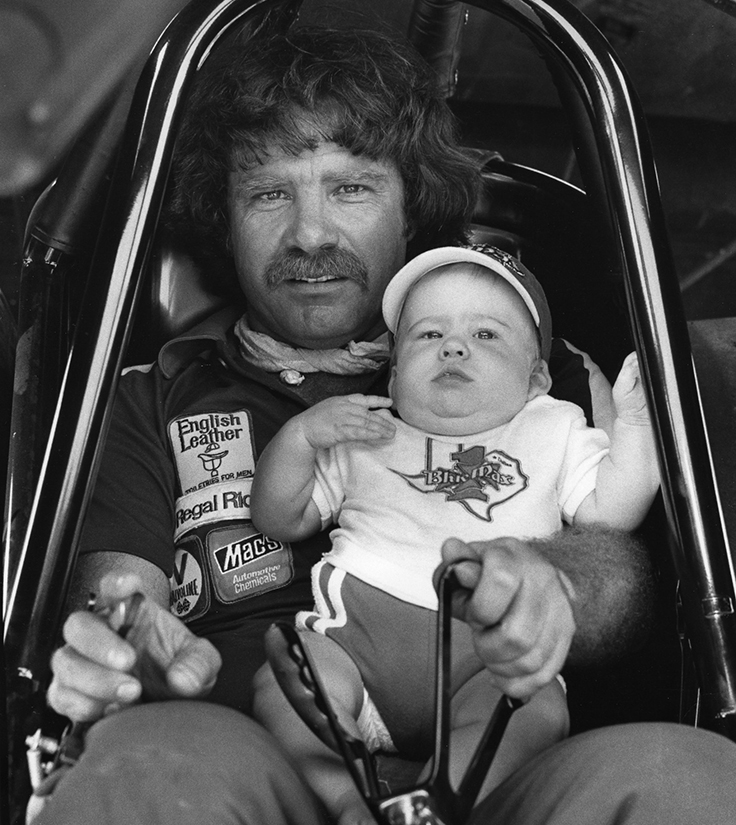
Ryan Beadle, who we all met for the first time in 1980 in this sweet photo with his father, will accept for the “Blue Max” hero, either in Rockingham, N.C., close to where he lives in Charlotte, or in Dallas, where the Blue Max and Beadle names still resonate with the fans. As a youngster, Ryan got to see his father in action at the drags and remained active in motorsports as legal counsel for the NASCAR operations of Rick Hendrick and Dale Earnhardt Jr. before moving into the world of real estate development.
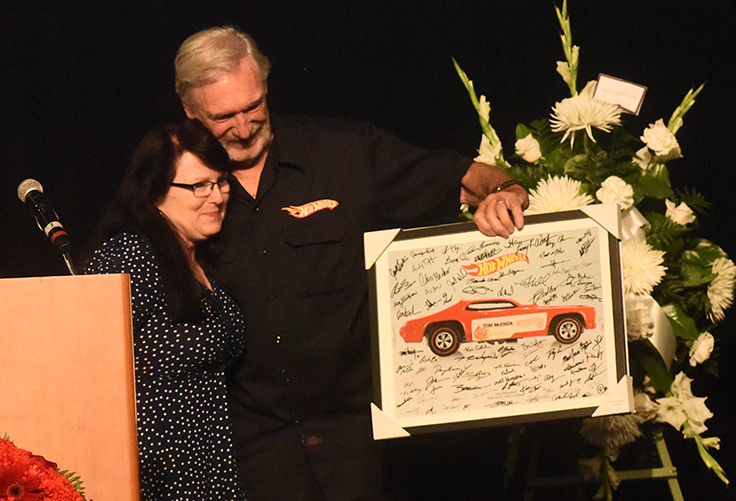
I talked to McEwen’s daughter, Katie, whom I had previously met at “the Mongoose’s” celebration of life in July 2018. She remembered me all these years later and is thrilled to have her father remembered. She’ll accept for him sometime later this year, in either Las Vegas or Pomona.
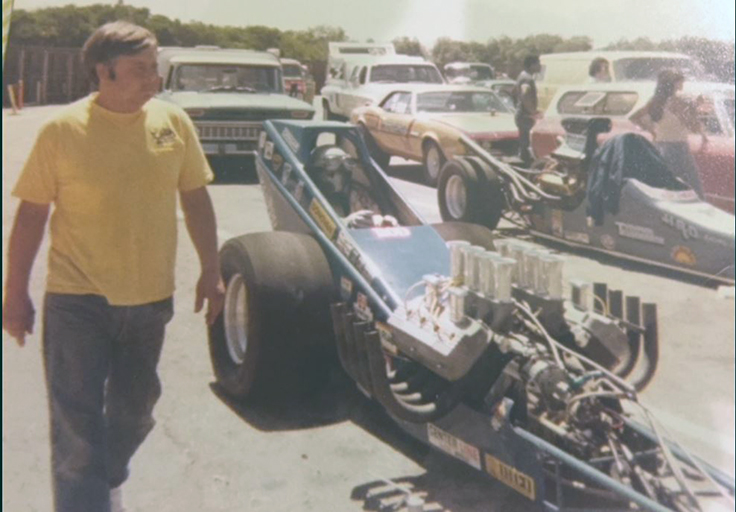
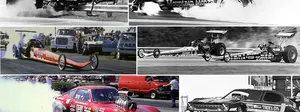
Speaking of McEwen, Jeff Thomas, who helped create the ultra-cool (and helpful-to-me) 70sFunnyCars.com site, passed along this photo of the ex-“Mongoose” Hot Wheels front-engine dragster. In the column I wrote a few weeks ago about those weird-looking dragsters, we knew that Don Prudhomme’s similar car went to Art Marshall (the photo from Maple Grove Raceway in that column was actually taken by Thomas!), but there was no trace of McEwen’s blue version. Well, here it is in the staging lanes at Orange County Int'l Raceway now sporting an injected Hemi powerplant. Anyone know who this is?
And speaking of follow-ups, I’m always grateful when readers of this column do their own deep dives into history, and few are better than “Chicago Jon” Hoffman, who shared the photo below of an incident that was mentioned in my column about The Great Burndown at Indy 1971 between Don Garlits and Steve Carbone. I mentioned that the duo had squared off at an AHRA Grand American meet at Marion County Int’l Raceway in Marion, Ohio, the week before the 1971 U.S. Nationals.
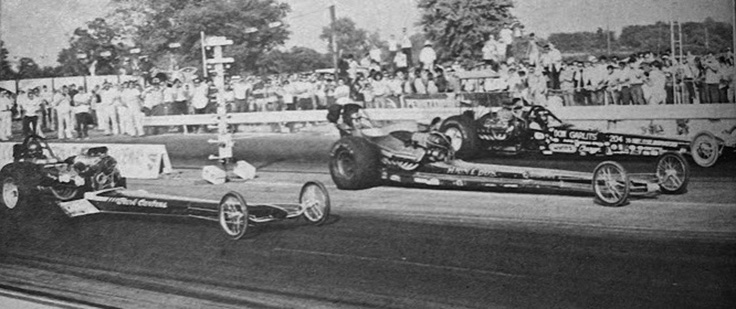
I wrote that Garlits had defeated Carbone there in the final round after Don Cook broke and Carbone stepped in under the old “break rule,” but what I didn’t realize was that they simply pushed Cook’s broken mount onto the centerline and ran on either side of him.
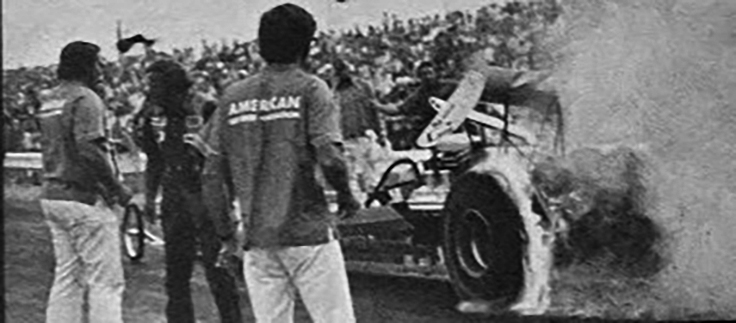
The photo came from a 1977 special “Photo Greats” edition of Super Stock & Drag Illustrated. On the same page of the Marion County photo was this wild picture showing Flip Schofield’s Top Fueler at the same event the next year with the wing breaking and the tires on fire mid-burnout. The caption reports that a crewmember had put the bottle of traction compound on the rear tire while Schofield was getting ready to run, but that the header flames ignited the fumes, catching the tire on fire, and when the tire blew, it took out the wing. Wild. One more reason why “glue” isn’t allowed anymore. Thanks, Jon!
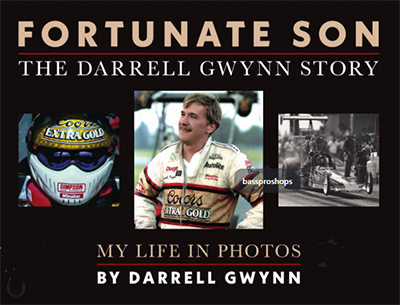
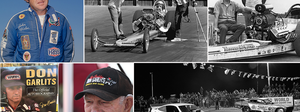
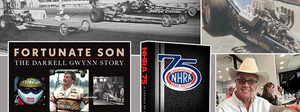
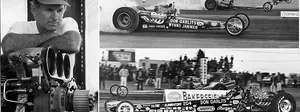
And speaking of books, be on the lookout soon for my interviews with Florida’s two most famous racers with the same initials, Don Garlits and Darrell Gwynn, who have new books coming out soon. “Big Daddy,” who has written several books, including Tales From the Dragstrip and Don Garlits and His Cars, just texted me that he’s completed his newest autobiography (“My book is finished! Praise God! 137,950 words, 443 pages, been on it over a year!), and Gwynn, who first shared the news with me at the national event earlier this year in Maryland, soon will be offering his book, Fortunate Son, The Darrell Gwynn Story, which will be a photo book of memories from his great career. I’ve known both for decades and, because of our long friendship, Gwynn has asked me to host a press conference for him in Indy to talk about the book.
And speaking of Gwynn (don’t you just love these convenient segues), I have to recount a hilarious interaction we had a few months ago involving Artificial Intelligence. While I am a fan of AI as a way of quickly gathering information (most of us have forsaken traditional Google searches for AI-powered searches), it’s still very fallible. I still abhor content created by those means and expressly frown upon it for the creation of stories for NHRA National Dragster and NHRA.com, and its uncanny ability to put together words in creative (yet tellable) form allows neophytes to submit the kind of quality-sounding writing that my long-running colleagues and I have honed through decades of experience and tens of thousands of stories [rant over].
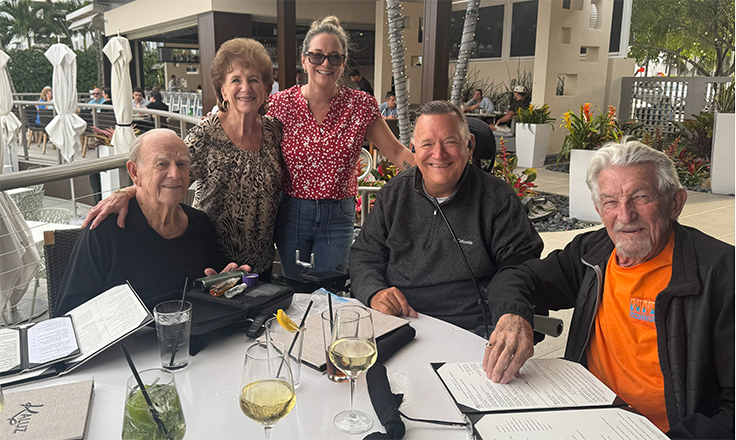
Anyway, Gwynn was at dinner with his family and former NHRA Vice President Steve Gibbs, and they were struggling to come up with a racer’s name. He turned to me via text and asked if I remembered a California driver with a peg leg on his clutch leg. I racked my brain and, after determining he wasn’t talking about pit-area bon vivant “Porky the Pirate,” I plugged the query into ChatGTP.
What it gave me back, in two separate queries, blew my mind. AI chat bots have been known to “hallucinate” in their responses, but even a chatbot on acid shouldn’t tell me that both Billy Meyer and “Jungle Jim” Liberman drove with artificial legs.
Response 1: The "peg-legged" NHRA driver most people are thinking of is Billy Meyer. Meyer lost part of his leg in a motorcycle accident before his pro racing career but went on to become one of the top NHRA Funny Car drivers of the late 1970s and early '80s. He even won the 1980 NHRA Funny Car championship, which makes the accomplishment that much more remarkable.
Meyer never lost a leg (though he did have some perilous rides) and obviously never won the 1980 NHRA Funny Car championship (he didn’t win any).
Response 2: The “peg leg” reference in drag racing lore is almost always tied to Jim “the Lapeer Flash” Liberman. Liberman lost part of his leg in a motorcycle accident before his drag racing career and used a prosthetic leg. That’s where the nickname and stories come from. He went on to become one of the sport’s most colorful and popular Funny Car drivers in the late ’60s and early ’70s, proving you could compete at a high level despite a serious disability.
Oh wow, where to start here. “Jungle Jim” was “the Lapeer Flash”? And, well, we all know that he never lost a leg.
For the record, several other AI bots (Microsoft Copilot, Claude) that I asked did come up with relevant answers, most correctly about double-amputee Pro Stock Motorcycle rider Reggie Showers and Dom Lagana, the former Top Fuel driver who lost both legs in a car crash, and one even pointed towards Garlits (who lost half a foot). For the record, the name that Gwynn and Gibbs were trying to come up with was supercharged gas racer Chuck Finders.
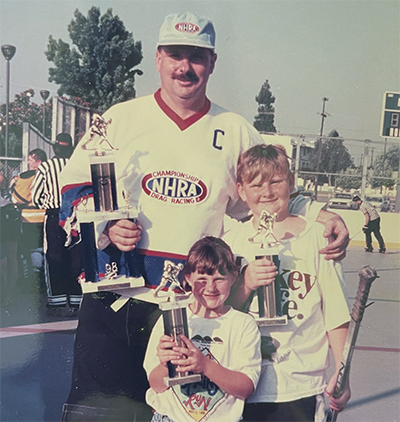
Mostly unrelated to drag racing, I made another pit stop on the road to OldManHood by finally deciding to hang up my gloves and end my hockey career. My gear had been sitting unused in the garage since my heart scare of December 2022, and I just never got back. I had started playing late, at age 30, and played for 32 years (do the math). That's me decades ago with my kids (now 37 and 36 years old, respectively, when NHRA sponsored our team to championships). I was still well into it when COVID-19 hit in 2020. League play was canceled for months, but we did get back to skating some time late in 2021 under strict guidelines (no use of locker rooms, masks strongly advised) and then my ticker almost went boom.
They were 30 glorious years, the last dozen or so spent playing on the same team as my son, who was a superstar goalie that led us to many championships. I loved everything about the game: the speed, the intensity, and being part of a team. I loved strapping on the gear, the helmet and the pads, like gladiators ready for the arena. John Force has said before that when he realized he was not going to make it as a pro football player, he switched to racing because he could still pull on a helmet and be part of a team.
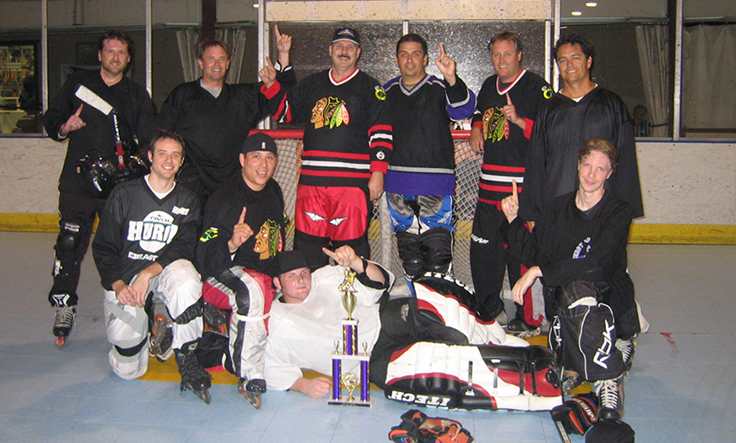
Me, I was a below-average skater with a middling wrist shot and no slap shot to speak of, so I specialized in defense, which meant recklessly diving in front of opponent shots to block them and standing up physically for my teammates when the other team tried to take liberties. It was my way of contributing. Not only did I play alongside my son, but with current NHRA President Glen Cromwell, who was an offensive star. He and I still joke about the times I played bodyguard for him and how I had to be cautious when I played against him when he was on other teams. A lot of people I know in the NHRA world are big hockey players, guys like Tony Schumacher, illustrator Greg Ozubko, Insider regular Frankie LoCascio, Bob Tasca III's sons and John Force's grandsons. I used to talk hockey as much as nitro with the late great Dale Armstrong and still compare notes with Funny Car ace Jeff Arend (Canadians both, eh?).
As I drove to the rink last weekend to donate my gear, I was overwhelmed with emotion, thinking about all the nights my son and I took that drive and sized up our opponents. As goalies do, my son kept a great mental “book” on every player in our division, and he’d tell me things like, “Remember that righty [right-handed shot] with the blue helmet; he never passes” or “That lefty likes to go top glove side.” I imagine these are the kind of conversations that racing teams have on their way to the track, maybe reminding one another of an expected opponent’s staging habits or even the peculiarities of the track they were heading toward.
As I pulled up and prepared to make my retirement official, I wondered how many racers had towed their cars to the track for the last time to hand it over to a new buyer, and if they felt a tinge of the same regret I did as I stepped into the building and heard the familiar sound of pucks on the boards, bodies clashing, and the smells (if you’ve ever been to a rec-league rink, you know what I mean). I almost decided to gear up for one last game, but the memories of a broken ankle, broken fingers, and stitches were enough to give me pause. For the last three decades, being a hockey player was part of who I was; I remember going to scary doctor’s appointments and telling myself “You’re a hockey player; you’re tough. You’ve got this,” and now I’m just going to be a humble scribe telling old stories.
And finally, there’s this interesting stat about this column and my other drag racing writing work. It's no surprise that between this column, my National Dragster work, my NHRA.com work, and the recent books, I do a lot of writing. I’ve had the Grammarly plug-in for web and Dragster work that is kind of an advanced version of the baked-in spellcheck for years (it tells me 225 weeks, or about four years), and that it has analyzed 25,741,669 total words that I’ve been involved in creating or editing (almost 26 million words? That’s a lot). In addition to watching for punctuation and spelling, it also tracks your work and sends you email updates with ego-swelling subject lines like “You’re a writing powerhouse!” and “This is how excellent your writing is lately.”
Here’s the most recent report:
Productivity: Grammarly analyzed 155,760 words. You were more productive than 95% of Grammarly users.
Accuracy: Grammarly showed you 239 alerts. You were more accurate than 84% of Grammarly users.
Vocabulary: You used 4,058 unique words. That’s more unique words than 91% of other Grammarly users.
These tones were detected in your writing: Confident (24%); Admiring (16%); Formal (16%); Joyful (12%); Assertive (9%); Optimistic (8%); Informative (6%).
I can totally understand why drag racing jargon and names rank high in uniqueness because most other users aren’t writing about “holeshots” or “superchargers,” and the productivity and accuracy are notes I need to send to my bosses before my next annual review. The fact that the major tone of this column is confident and admiring rings true as well.
Fun stuff. Fun column. Hope you enjoyed it, and feel free to drop me a line about anything that’s piqued your interest.
Phil Burgess can be reached at pburgess@nhra.com
Hundreds of more articles like this can be found in the DRAGSTER INSIDER COLUMN ARCHIVE
Or try the Random Dragster Insider story generator