

Don Garlits and Darrell Gwynn; their lives in words and photos in new books

Random ramblings and rumblings, the sequel
Random ramblings and rumblings
Memories of Englishtown
Remembering Steve Ambrose
-
Right back where we started from: Winternationals is back at No. 1
Meet Larry Wood: The man whose designs launched a million hot rod dreams
Can you imagine a toymaker designing your Top Fueler? 'Snake' and 'Mongoose' could
For the love of old drag racing photos
The ultimate Funny Car winners quiz
Still popular after all these years: Catching up with fan favorites Eddie and Ercie Hill
Eddie Hill, the early years
55 years ago, Don Garlits forever changed the look, feel, and future of Top Fuel racing
On a roll: A look at some all-time great NHRA Drag Racing success streaks
NHRA's Top 75 Moments: Bernstein, 'Big,' and Shirley reflect on making history
- ad
Funny Car set to turn 1,000: A look back at the milestone races along the way
Beyond the Top 75s ...
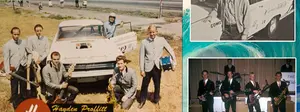
Wait ... Jim Head was in a 1960s surf band promoted by a drag racing legend? Yep.
More Martin memories
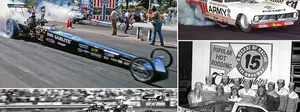
The Popular Hot Rodding Championships put U.S. 131 in the national spotlight
Friends we lost in 2025
Re-telling NHRA history: The 75th anniversary book and other special projects
It was John Force's world, and we were all thrilled to be living in it
The Joyce of Drag Racing Photography
Two legends: 'Big' and Bakersfield
- ad
When did we start doing that? Tracking some of the biggest changes in our sport
From 10-time dominators to one-time winners, a history of Indy Top Fuel champs
Legend to legend: Don Prudhomme on Don Garlits, Indy, and other great takes
NHRA Rookies of the Year: A look back at where some fabulous careers began
NHRA national event history: A look at the tracks and stories that drove the sport
Can you imagine a toymaker designing your Top Fueler? 'Snake' and 'Mongoose' could
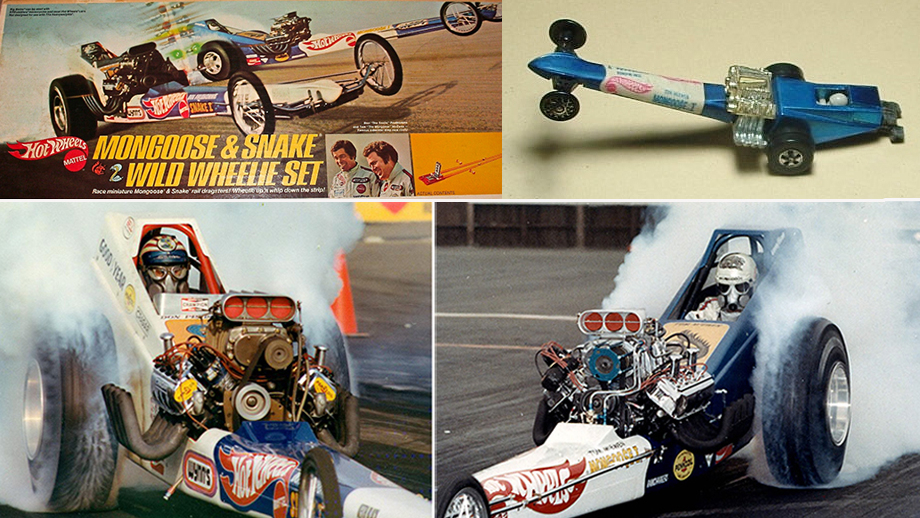
If there have ever been two more misunderstood front-engine Top Fuelers than the 1971 Hot Wheels rails of Don Prudhomme and Tom McEwen, I don’t know what they are. To say that they were not only misunderstood but also maligned and mocked is a little like saying that the Hotel California had an unreasonable checkout policy.
They are the only dragsters in the sport’s history whose design was dictated by a toy maker and thrust upon professional drag racers, and not just any professional drag racers, but two of the sport’s all-time greats.
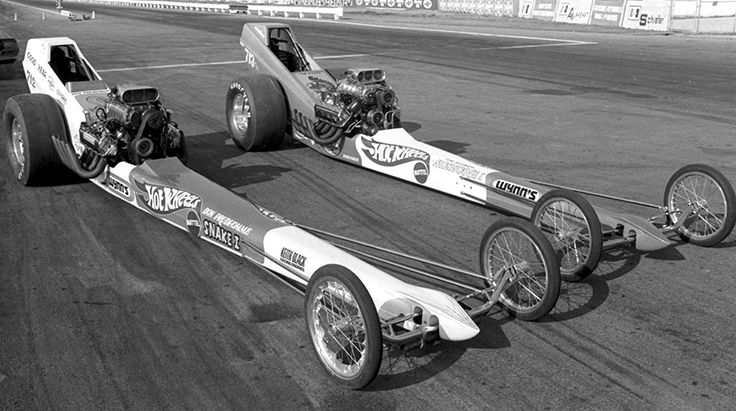
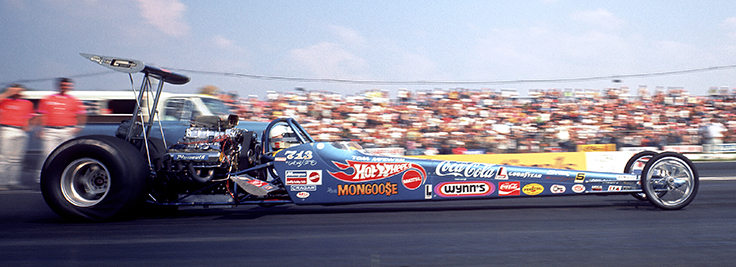
The unconventional-looking dragsters — often deridingly referred to as the “slab-sided” dragsters — were designed solely so that they would work in Hot Wheels’ new Wild Wheelie set (more on that later) and pretty much didn’t look like anything else out there, but it was what Mattel wanted, and what Mattel wanted, they definitely got. In a tail wagging the dog scenario, Mattel created the design for the rear section of the toy cars, and our heroes had to go along with it in real life.
This is such a juicy topic packed with twists and turns that, forewarned, is going to run on the longish side, so grab a tall glass of your favorite beverage and pull up a comfy chair. Or as that Beverly Hillbilly Jed Clampett once advised, “Sit a spell, take your shoes off.”
The Hot Wheels deal
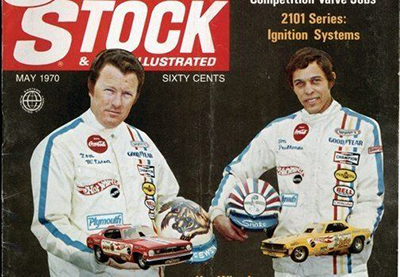
Before we go charging wheels-up into this story, I need to put it into the proper context, and to do that, we need to set the Wayback Machine to late 1969, when McEwen got them a meeting with Mattel’s Art Spears to pitch the sponsorship deal. The silver-tongued “Mongoose” worked his magic, and Mattel signed Prudhomme and McEwen to a very lucrative Hot Wheels sponsorship that, of course, included selling millions of miniaturized versions of the duo’s new Plymouth-bodied Funny Cars — a yellow Barracuda for Prudhomme and a red Duster for McEwen.
Before 1970, Prudhomme had never driven a Funny Car, having been weaned on SoCal dragster culture since his teen years and as a member of the Burbank Road Kings. McEwen had run some Funny Cars, but they both were still largely dragster guys at heart.
If it weren’t for the Hot Wheels deal that required him to be in a Funny Car, “Snake” probably would have been a Top Fuel guy for life. He was, after all, at the height of his Top Fuel powers, having just won the 1969 NHRA Nationals in Indy in his bare-chassised Wynn’s Winder dragster.
The 1970 preamble
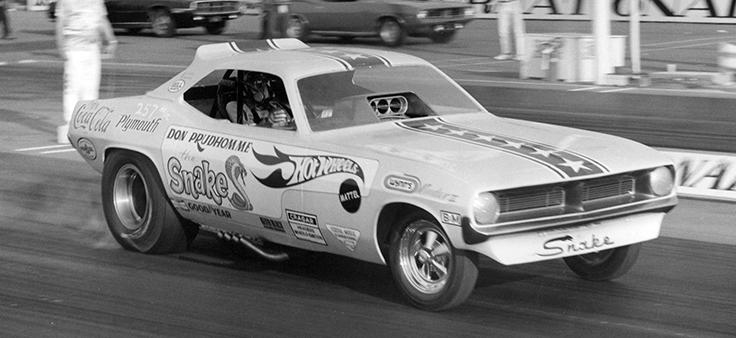
In 1970, Prudhomme ran both the Hot Wheels Barracuda and the now full-bodied Wynn’s Winder (which, oddly, did not have any Hot Wheels branding on it), but the Funny Car was, by design and for maximum national exposure, mostly a match race car, while the dragster did the heavy lifting at national events.
“Snake” ran both cars at the 1970 NHRA Winternationals but failed to qualify the Funny Car (second alternate) in its debut. McEwen did exactly the opposite, qualifying in Funny Car (round-one loss) but badly missing the dragster field.
Both skipped the NHRA Gatornationals completely, then both qualified their Funny Cars at the NHRA Springnationals in Dallas, where Prudhomme went to the semifinals before losing to Gene Snow, and “the Mongoose” broke in round one. Prudhomme then won Indy again in Top Fuel in the unforgettable final with Jim Nicoll, while Jay Howell drove his Funny Car (second-round loser), and McEwen lost in round one (again) in Funny Car.
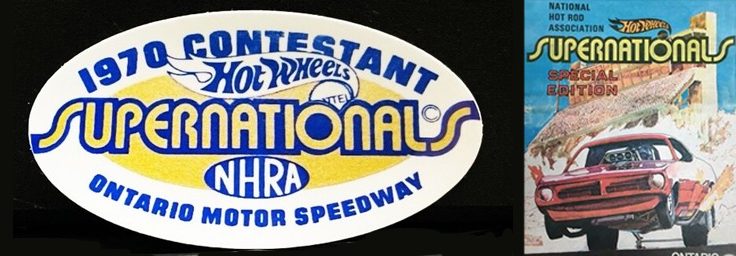
Both then skipped the NHRA World Finals back in Dallas and closed out the season back in their Funny Cars at the inaugural NHRA Supernationals at Ontario Motor Speedway. Prudhomme was driving the Funny Car largely because the event was sponsored by Hot Wheels, and he put veteran Butch Maas in his dragster. Prudhomme qualified No. 1 (7.04) but got beaten by Richard Tharp in round one, while Maas suffered the same fate at the hands of Tony Nancy. McEwen failed to qualify.
Although the national event success of the Hot Wheels Funny Cars was not great, their barnstorming of the country with the Funny Cars was a huge hit; I don’t think that Mattel even knew what they had on their hands until the boys went coast to coast, signing autographs and drawing legions of fans to watch their rivalry grow.
A wheelie wild idea is born
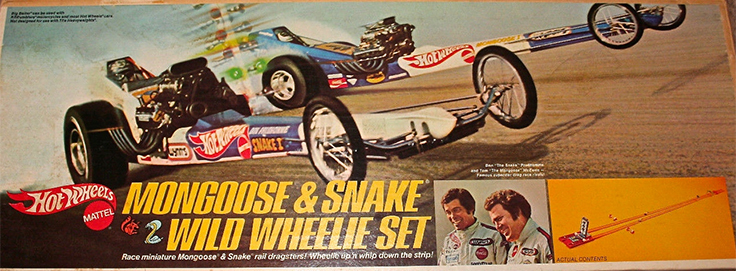
The success of the Funny Cars at the dragstrip naturally drove sales of the Hot Wheels cars, so Mattel wanted to add a dragstrip-specific set to its product lineup in 1971 to capitalize on the popularity. And what’s a more iconic sign of a powerful car than a wheelie, right? And so the idea of the Wild Wheelie set was born.
Mike Bunge, perhaps the world’s foremost Hot Wheels memorabilia collector, was happy to collaborate on this story and send me some great images. (Being a lifelong Hot Wheels nut, I had introduced myself to Bunge a few years ago after seeing him on a Hot Wheels documentary, and we’ve been communicating back and forth on a few future Hot Wheels stories.)
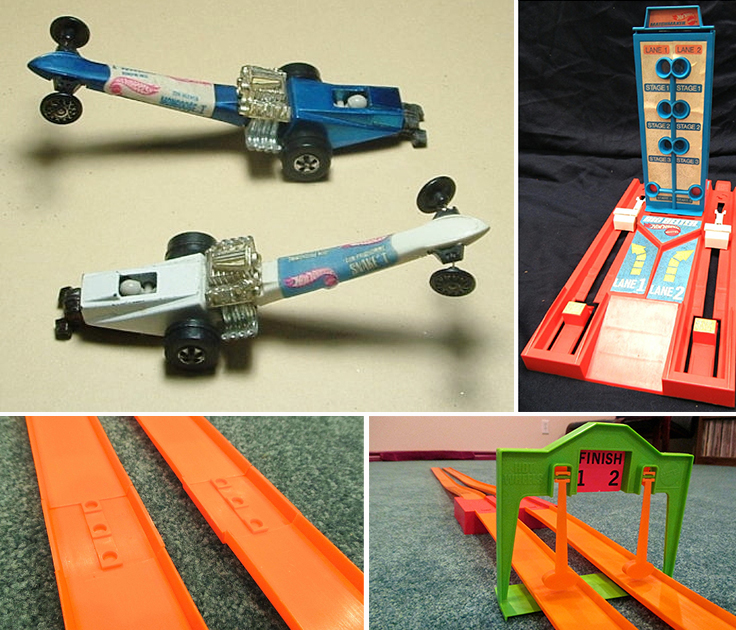
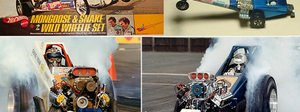
For those who don’t know (and there’s a very detailed explanation with very helpful drawings here), the miniature front-engine dragsters had a weight that would lock up into the tail so the car would wheelie once it left the “Big Belter” rubber-band-powered starting-line launcher/Christmas Tree. The cars then rode on a pair of wheelie wheels, and before they reached the finish line, a purpose-built track connector with three raised dots tripped a latch beneath the car that released the weight, and the front wheels came down. The cars passed through a finish-line gate, then over a trapdoor that hid a parachute that was snagged by the cars’ front wheels. It was quite ingenious.
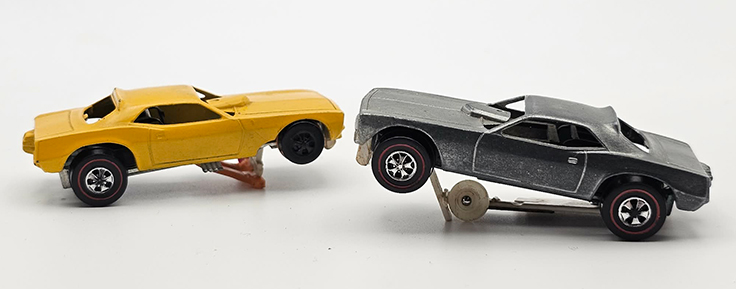
However, as cool (and more realistic) as the thought of wheelstanding Top Fuelers is, Mattel originally tried out the idea for the already-established Funny Cars, but, try as they might, they couldn’t get them to wheelie and still look like race cars. They had an extra set of wheels that dropped down and lifted the car up. Here’s a photo that Bunge sent me; I think we can all agree it just doesn’t look right.
Meet Larry Wood
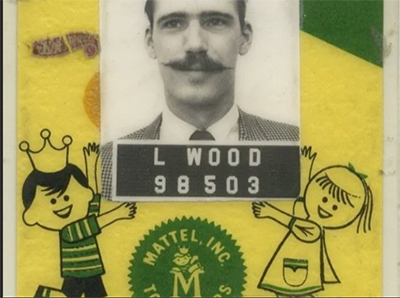
So the challenge was then laid down upon brilliant Hot Wheels designer Larry Wood — at the time the lone survivor of a three-member design team, the only one who somehow could meet the demands of churning out dozens of new Hot Wheels ideas a year — to come up with a dragster configuration that worked with the launcher and did all of the things it was supposed to do.
Wood, who years later would be dubbed “Mr. Hot Wheels” by fans for his legendary five-decade career with the brand, had joined the design team in 1969, not long before the Prudhomme/McEwen deal was announced, when he had been charged with faithfully and meticulously duplicating the already-existing Funny Cars for the first production run. It was a soaring moment in his life because, not too many years before that, he had been just a drag racing fanboy hanging onto the fence at Lions Drag Strip, cheering them on from the cheap seats, and now he was working hand in hand with “the Snake” and “the Mongoose.” Real pinch-me stuff.
“The hard part about that was trying to make them look like real dragsters, but, because of the weight, I had to have that funny back part,” Wood told me late week in what was a pinch-me moment for me, too, to be talking to the guy whose designs pointed me towards a career in drag racing. (Look for a future article here on Wood’s career.)
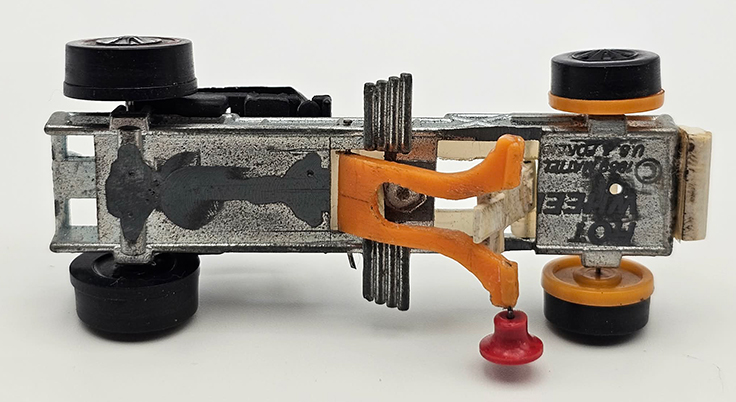
Wood also admitted that the original Funny Car prototypes “were kind of Mickey Mouse compared to when the dragsters were made, where we could actually slip that weight up and pull it and make the car do a wheelie.
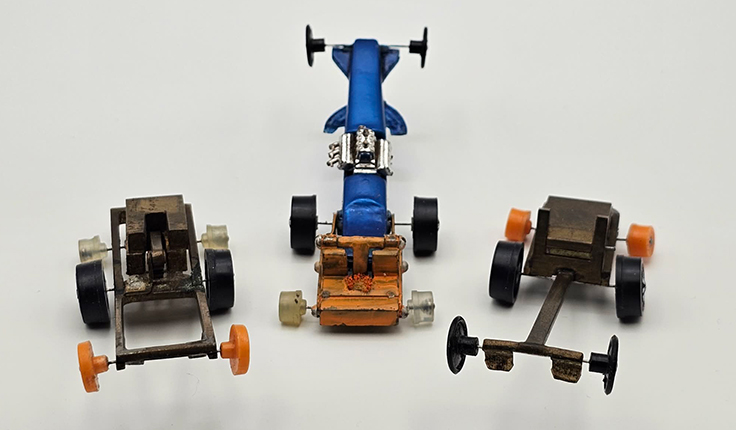
“There were probably two or three different designs (executed in brass) that we tried until we came up with that one; it had X amount of weight to lift the front of the car. We know it didn’t look the best, but because 99% of the Hot Wheels buyers probably never had seen a real dragster before, we thought it was OK.”
In what has to be a heartbreaking pronouncement for an artist, Wood good-naturedly admits that the design was “ugly” and “terrible,” but in a form-follows-function world, “It was the only way to get the weight up into the body of the dragster.”
So, who’s gonna tell the boys the news?
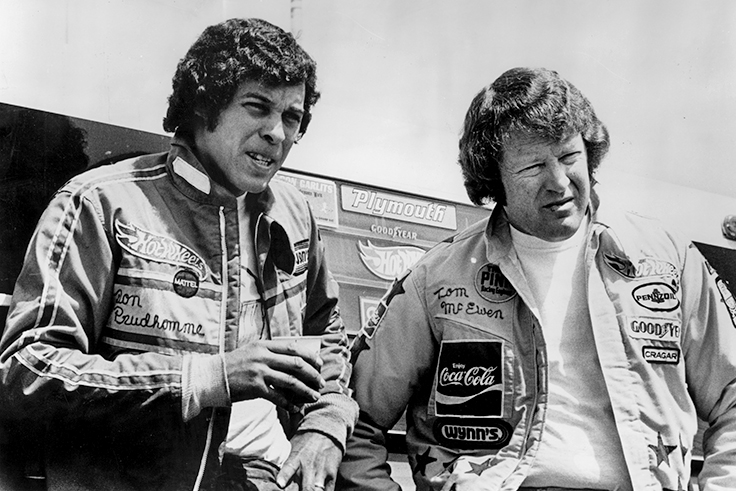
Once the concept was approved, someone had to break the news to Prudhomme and McEwen about how their dragsters should look for 1971.
Consider this: Prudhomme and McEwen were at a height of worldwide popularity, notoriety, and name recognition, probably greater than any drag racers in history. I mean, as "big" as he was at the dragstrip, kids weren’t racing Don Garlits' dragster down orange racetracks in their bedrooms.
So, imagine the temerity, the balls, the chutzpah that Mattel — a company known previously and primarily for making unrealistically curvy girl dolls with to-die-for accessories — would dictate a design to experienced drag racers: “Um, excuse me, Mr. Snake. We know you’ve won Top Fuel in Indy the last two years, but we’d like you to throw that out the window and try this weird new design.”
But the boys weren't about to deny the golden, well, goose that had turned them into worldwide fan favorites and padded their pocketbooks with the kind of bread that meant that they could buy the best parts, stay at better motels, and eat somewhere other than the Waffle House. (Not that the Le Château Waffle wasn’t still a welcoming beacon on a dark highway during an all-night tow between Union Grove, Wis., and Gary, Ind.)
Fortunately, that breaking bad did not fall on Wood, but on higher-ups at The House That Barbie Built, and so began the transformation that would shock and amuse Top Fuel fans. ”Even though I knew how bad it was gonna look,” Wood reasoned, “the toy wasn't quite so bad.”
Wild Wheelies, wilder cars
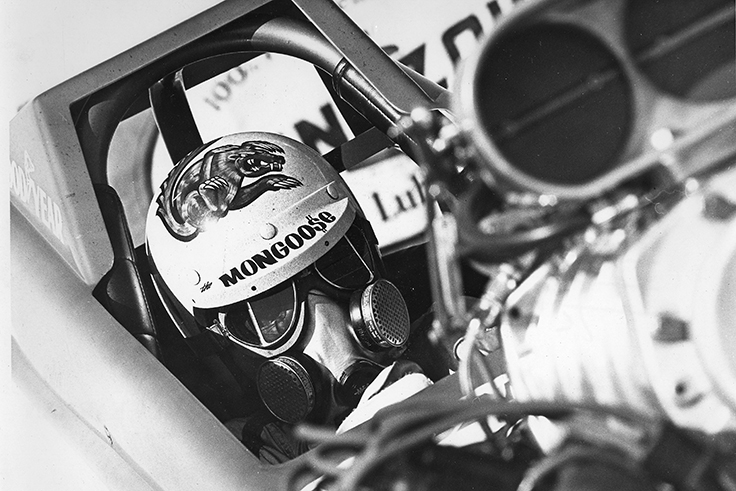
Although the real cars looked identical (other than color, obviously; white for Prudhomme, blue for McEwen) when they rolled out at the 1971 Winternationals, they were not. Prudhomme’s Don Long-chassised car was built around his 1969-Nationals-winning dragster, while McEwen opted for new tube from Woody Gilmore. The weird cockpit coverings were added to both cars by master metalsmith Tom Hanna. In a worst-case example of Terrible Timing, Mattel unveiled these front-engine cars in the season where Don Garlits won the Winternationals in his rear-engine car, and slingshots quickly began to look rather obsolete.
In his book, Mongoose: The Life and Times of Tom McEwen, “the ‘Goose” called it "the ugliest dragster ever built,” said that people likened it to Texas roadkill, that they were as heavy as their Funny Cars, and that he disliked the claustrophobic feel, which reminded him of the Gene Adams “Shark” car he drove years earlier.
Prudhomme told me recently that he didn’t mind the design as much, but did allow that “everybody kind of laughed at them because they looked so different.”
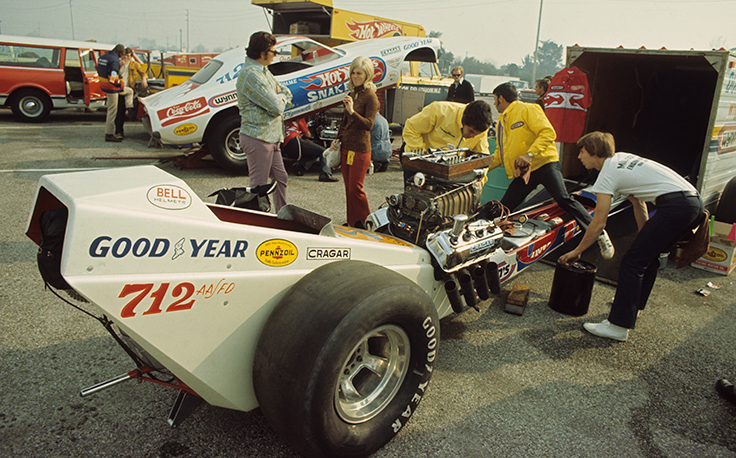
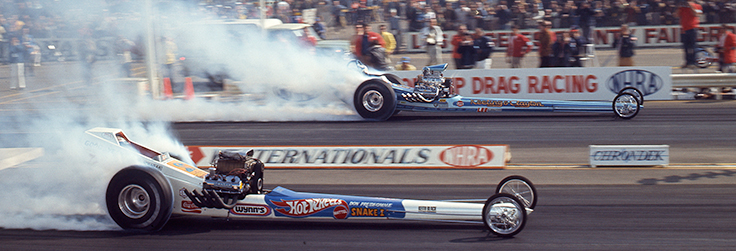
Prudhomme ran both the dragster and the Funny Car in Pomona and lost in the first round in both; the dragster lost to Rick Ramsey and the 1970 Supernationals-winning Keeling & Clayton car (above).
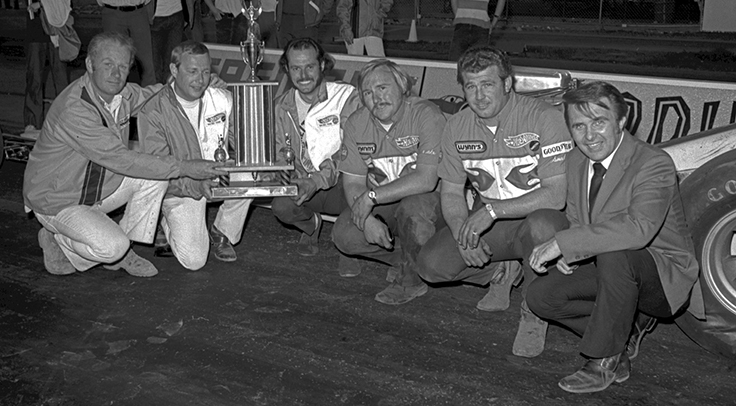
Prudhomme then put Mike Sniveley in the dragster for Fremont Dragstrip's Northern Nationals match race, while "Snake" drove the Funny Car. Snively (third from left above), who had replaced Prudhomme in Roland Leong's Hawaiian in 1966 and, oddly enough, had duplicated Prudhomme's 1965 Winternationals and NHRA Nationals-winning double, proved to be a great choice as he won the event.
By June, Prudhomme had ditched the car entirely for the equally dysfunctional rear-engine Hot Wheels wedge, which he debuted at the Springnationals in Dallas (qualifying No. 17 but unable to make the first-round call). A few races later, Prudhomme ditched the heavy wedge body and ran the rear-engine car sporadically the rest of the season. The front-engine Hot Wheels car was sold that winter, but more on that in a second.
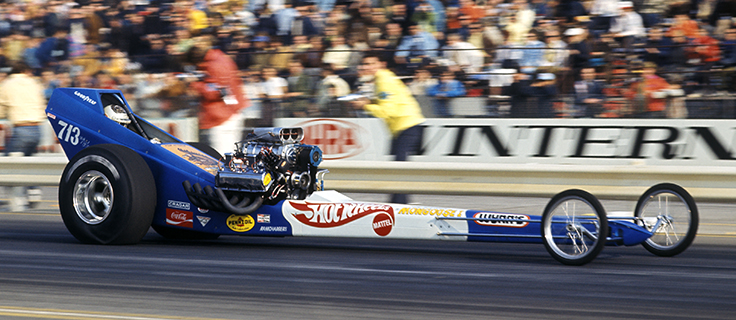
McEwen couldn't qualify his Funny Car in Pomona and lost in round two in the dragster, but stuck it out with his front-engine car, racing it and the Funny Car at many events and actually enjoying some success with the dragster against both Garlits’ Swamp Rat 14 and “Snake’s” Wedge. He went to the third round of Top Fuel at the Dallas Springnationals but lost in round one of Funny Car and shockingly DNQ’d in both in Indy.
Donnie Couch, a longtime crewmember on the McEwen team (and for countless other famed quarter-milers), was just a teen at the time but remembers, “For Tom to go back to the dragster, it wasn't his favorite thing. He really liked that Funny Car at that point, but he stuck with it even though he knew that front-engine cars were not going to be the thing anymore. He mostly did it for the Hot Wheels people, to keep them happy because he just thought Hot Wheels was better for the sport and better for him.“
A week after the dual Indy DNQ, even McEwen had had enough and put in an order for a rear-engine Garlits chassis that debuted at Orange County International Raceway’s season-ending All-Pro race. He was Customer No. 1. Chris Karamesines got No. 2. The front-engine car was sold to someone whose name Couch could not remember, other than that he was on the East Coast.
So, that brings an end to the saga of the Wild Wheelies front-engine Hot Wheels cars, right?
Wrong, wheelie-wheel breath.
Questions. I’ve got questions ….
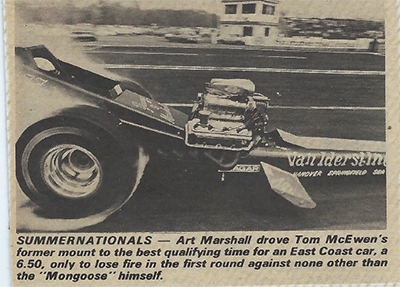
For years, it was written that Art Marshall scored his win at the 1972 Grandnational outside of Montreal — the final front-engine Top Fuel win in NHRA history — in the ex-McEwen car. It wasn’t until I met Marshall at the 2011 Gatornationals and wrote a subsequent column on him that he assured me it was actually the ex-Prudhomme car that he and partner Don Young had purchased and turned into a surprise winner.
To be honest, my predecessors here at NHRA National Dragster are probably largely to blame for the confusion, thanks to the errant caption shown here from the Aug. 14, 1972, issue covering the Summernationals, and it may also have been because McEwen’s car was blue and Marshall and Young had repainted “Snake’s" white car blue (although a darker blue than McEwen’s). There also seems to be a telltale extra spoiler lip on top of the bodywork on Prudhomme’s and Marshall’s cars that was not on McEwen’s.
But, lo and behold, when I talked to Prudhomme a few weeks ago, he corrected me that, no, Marshall did use McEwen’s car and that he (Prudhomme) kept the white car for decades before selling it to Don Garlits for display in his museum. None of this added up.
This is where I love and hate being a drag racing historian. I was 99.9% sure that Prudhomme was misremembering, but I’m not about to call out my lifelong hero for forgetting something that happened decades ago. This is a common problem I run into, where I have the very unfair advantage of years of memorizing this stuff and being in possession of reams of results and scores of old magazines, but the drivers who I interview are only working their way through the cobwebs of ancient history when I put them on the spot.
It would be like someone asking, "Hey Phil, do you remember that great third paragraph of that 2010 column you wrote about wedge dragsters?" (For the record, I do not. I am, however, quite pleased with the intro paragraph to this story. It's not quite "It was the best of times, it was the worst of times" from Charles Dickens’ iconic A Tale of Two Cities or even "When I stepped out into the bright sunlight, from the darkness of the movie house, I had only two things on my mind: Paul Newman and a ride home" from S.E. Hinton’s seminal late-1960s tale of Oklahoman teenage angst, The Outsiders, but I still like it. Ask me about it a decade from now.)
And while I surely expect Don Prudhomme to remember everything that happened in the final round of his first win at the 1965 Winternationals, I would not expect him to remember his first-round opponent. (It was Willie Redford. Who? Exactly.)
Fortunately for me (and you), I love this detective stuff, and what I love most of all is knowing how to find out what I don’t know or what I need verified. So, I called Art Marshall. And then Art put me in touch with his old partner Young. Then I called Garlits to ask where he got the white car. And finally, I reached out to chassis builder Long for his memories. It all came full circle to where I now have no doubt. (Sorry, “Snake.”)
The Young & Marshall story
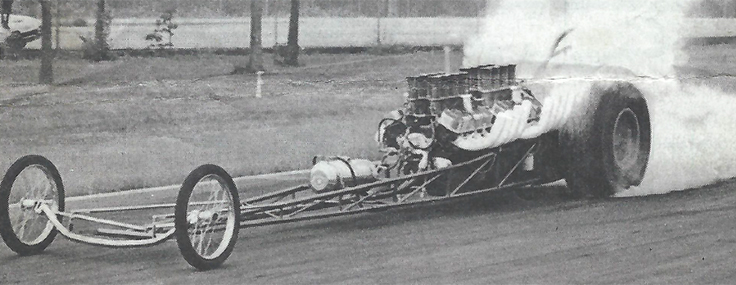
Marshall and Young originally had a twin rear-engine injected-fuel dragster that clearly was not going to work out in Top Fuel in the long run, so in 1971, they started looking for a real race car they could afford.
Marshall worked for Pete Van Iderstine at Van Iderstine Speed Center in Springfield, N.J., and, as it was back in the day, speed shops usually got their issues of National Dragster bulk shipped and often quicker than members got them at home, so he had a leg up when he spied Prudhomme’s Hot Wheels slingshot for sale in late 1971. According to Young, the team had actually been looking for a rear-engine car, but there weren’t many available, and they even briefly considered buying Prudhomme’s Hot Wheels wedge instead.
“We did see that rear-engine cars were still not perfected as of 1971, and they were working out the bugs, and we weren’t looking that far ahead,” Young admitted. “We decided to go with a true proven car. We had a poor showing in 1971 when we were trying to make the twin-engine Top Fuel car perform. The Hot Wheels car was for sale for $5,000, and the wedge was listed at $7,500. Looking back, the wedge probably would have been a mistake. If ‘the Snake' could not get it to perform, how could we on a limited budget and with East Coast winters?”
“I made the deal with Don Prudhomme over the phone,” Marshall remembers, “and Don and I and a friend who was part of the crew drove out to California to pick it up at Keith Black's shop. The car was there, and the trailer that we got as part of the deal actually used to belong to Roland Leong; it had the pineapples on the side of it. We drove it home.”
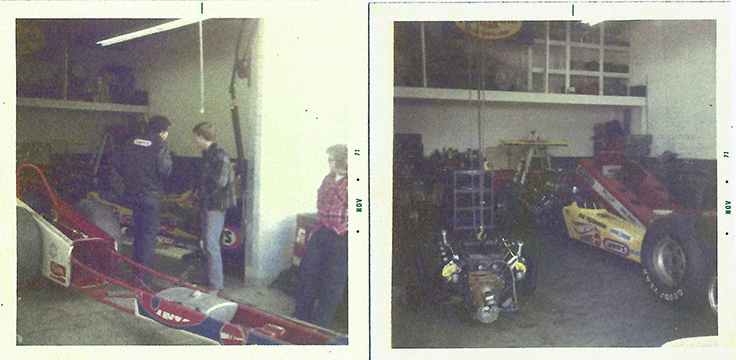
Young also sent along a couple of not-so-great Polaroid photos (dated November 1971) of the car with its trademark red framerails in the garage behind Black’s South Gate, Calif., shop to back up their claim, and Marshall found the original invoices (made out to Art Van Iderstine, a mistaken amalgamation of the names) and sent that to me, sealing the deal.
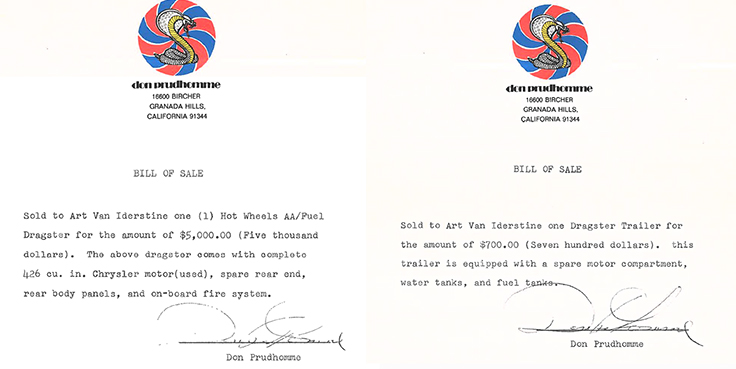
And there it is, ladies and gentlemen, and what a deal: a professionally built Don Long chassis, a 426 Chrysler engine (albeit used), a rear end, some body panels, and a fire extinguisher system, all for the meager sum of $5,000, or roughly $40,000 in today’s money. They also paid $700 for the trailer.
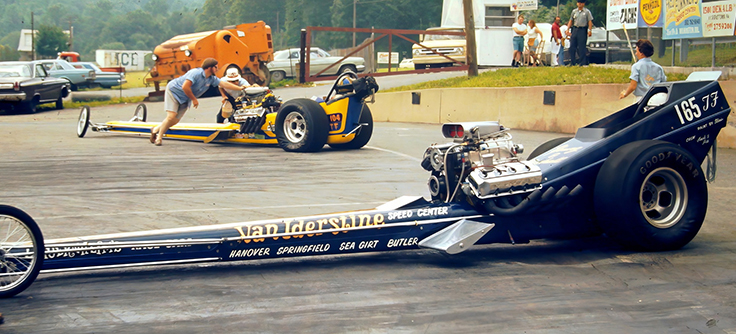
They towed everything back to New Jersey, where the late Slim Blaney in Tiselle, N.J., painted the car dark blue metallic, and the team added side canard wings. You can see the blue color of the car and the Prudhomme-added roof spoiler lip in this undated shot from Maple Grove Raceway.
The Van Iderstine sponsorship that rode into the history books on the car’s flanks was for nitro and alcohol and a place to store the trailer, and they were able to purchase parts through Van Iderstine at a vendor discount. Other than oil, which was supplied by Castrol, Marshall and Young footed the rest of the bill.
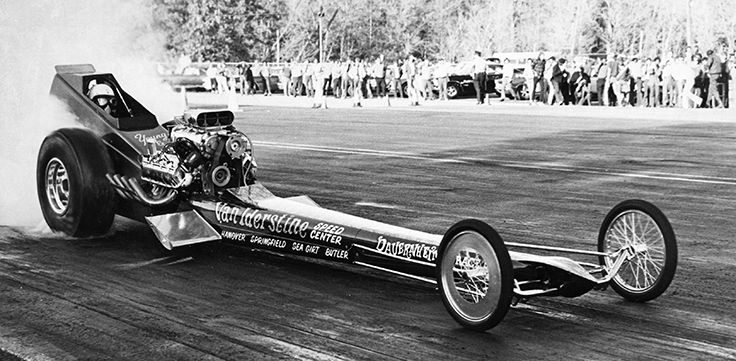
The car made its NHRA national event debut at the 1972 Summernationals, three weeks before the famed Grandnational win. Marshall qualified 12th with a 6.500, three tenths behind polesitter Clayton Harris’ rear-engine car, and, as fate would have it, his first-round opponent was McEwen in his new back-motored car. It couldn’t have gone worse for Marshall.
“This was just when they were changing the burnout procedure,” said Marshall. “It used to be you could do a burnout and coast past the starting line, but now you couldn't go across it and then push back, so the stopping distance was shorter, and, because of inexperience on our part, we didn't have the tank totally topped off and didn't have an extended pickup in the tank, so when I hit the brakes real hard, the fuel sloshed away, it lost fire, and that was that.”
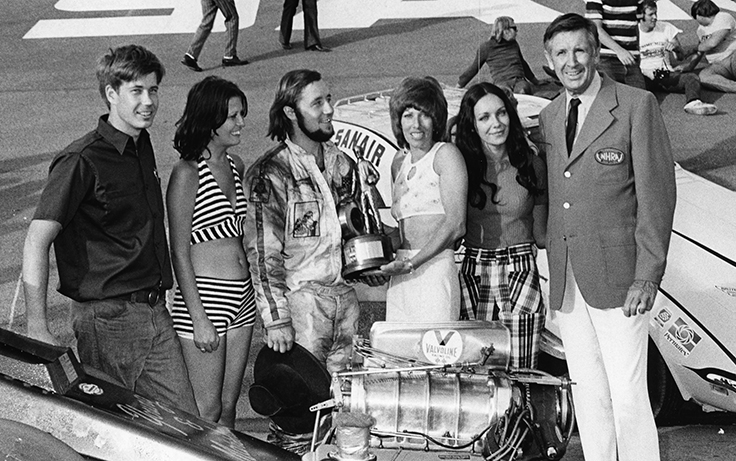
Not long after their historic Montreal win a few weeks later, the team — which also included Pete Keller and Jack Bashford — realized that rear-engine cars were here to stay and sold the car, and it disappeared for a time.
“I sold it to some young kid in New Jersey,” Marshall recalled. “I think his dad had passed, and his mom was just trying to appease him, and so he came into some money and wanted a race car. I was really hesitant about selling it to the kid because of his lack of experience, but I doubt he ever even started it.”
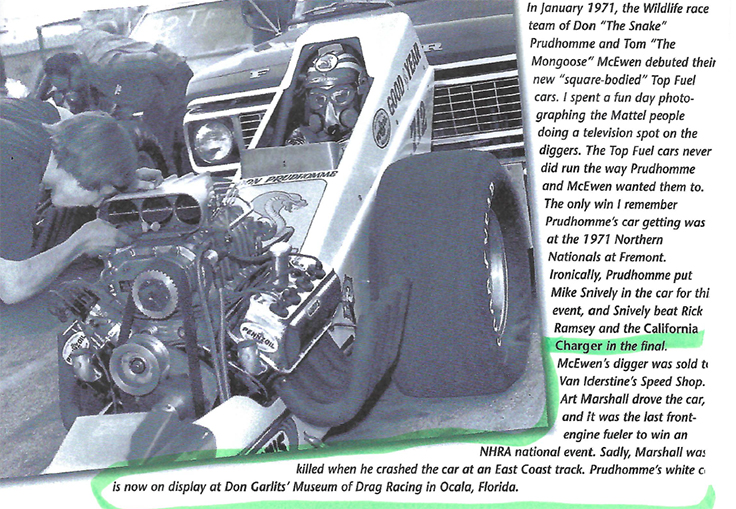
Marshall went on to drive a Top Fuel car for Randy Ditzel, Ralph Wagner, and Bill Curry in 1973, but they did not qualify for the 1973 Summernationals. For a time, Marshall disappeared from the public eye — one notable book not only had the car reported wrong but even reported that Marshall had died in a racing accident in the car (see above) — but has become more celebrated through places like this little watering hole and at nostalgia events.
“I thought everybody forgot about me,” he shared. “When we won, of course, nobody realized it at the time that it would be the last front-engine win, and then it got documented. Now I realize I'm always going to be there in the history books, because it's never going to happen again, and I’m very good with that.”
Young started a body shop, which he ran for 35 years, and put a deposit on a house with the proceeds from the sale of the car. “Life was evolving, and I had other dreams to fulfill,” he told me. “Art has continued to be involved in driving cackle cars such as the Great Expectations car. Pete has his own gas dragster, which he races locally. Jack went back to working as a mechanic and has since passed away.”
More unraveling to do
On the websites where they do correctly acknowledge the Marshall car as the ex-Prudhomme car (looking at you, DragList), it often says that the white Hot Wheels car was Prudhomme’s 1970 Indy winner, which in fact it was not (sorry, Bill Pratt).
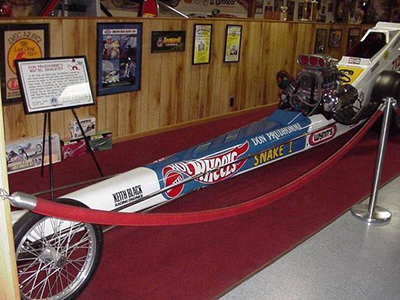
When I talked to Garlits about the provenance of the white Hot Wheels car, he remembers that he did NOT get it from Prudhomme, but that he bought it from someone in New Jersey; he thought it might have been Marshall, but wasn’t sure.
Garlits remembers that it had been painted (he remembers black, but the car was very dark blue) and said that the confusion on Prudhomme’s part may be because he did buy the 1970 Indy-winning Wynn’s Winder, the Hot Wheels Wedge, and one of the Army Funny Cars from Prudhomme for the yard-sale price of $20,000. Thus, the white Hot Wheels dragster and the 1970 Indy winner could not be the same car. Regardless, Garlits’ team was able to restore the Hot Wheels car to its original livery and has it on display at his museum.
The Long and short of it …
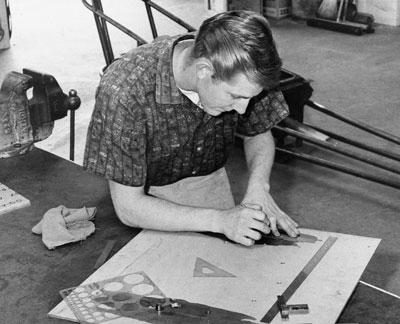
So, how do I know for sure that the white Hot Wheels dragster was not the 1970 Indy winner but, in fact, the 1969 winner? Because the guy who built both of them — Don Long — told me so.
In addition to having a keen memory, Long also has an encyclopedic accounting of every car that he has built, with invoices, work orders, and so on. (You can see several of them in the article I did about Shirley Mudlowney’s 1968 Don Long-built gas dragster here).
Long started building chassis in the early 1960s, and Prudhomme’s 1969 Indy winner, delivered on Dec. 3, 1968, was No. 041 to come out of his shop. (Long remembers that this dragster was originally ordered by Roland Leong in August, then transferred to Prudhomme when Leong decided to switch to racing a Funny Car.) The next Prudhomme car, the 1970 Indy winner, was No. 055, and, incredibly, Long cranked it out to him in just 15 days: Ordered Jan. 14, 1970, delivered Jan. 29. The Winternationals started the next day. Prudhomme qualified the brand-new car sixth and went to round three before wheelstanding his way to a loss against old mentor Tommy Ivo.
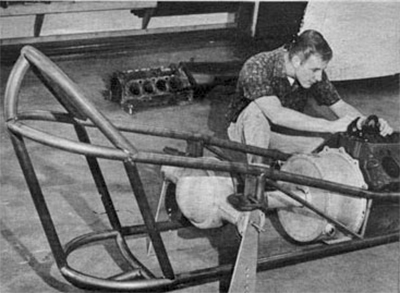
“Comparing invoices of 041 and 055, the wheelbase on 055 was five inches longer, and the engine location was noted,” Long added. “Being as the engine location was noted on the invoice for 055, but not on the invoice for 041, tends to make me believe the engine was ‘further out.’ I would say that this move was believed to improve performance, likely connected to better tires. Additionally, 041’s invoice shows the purchase of a mag firewall, whereas 055’s shows the purchase of a high-strength aluminum firewall. It’s easy to believe that the difference was due to a new safety rule.”
As we closed out our conversation (done entirely by email, at his behest), he asked, “Do you know that there are no known fatalities or serious injuries in a Don Long chassis?”
That’s a pretty stunning claim, given the rate at which Top Fuel drivers in the 1960s crashed heavily or died (or both). I asked him if that was because of something that he did to his cars, safety-wise, to make perhaps something his peers did not.
His answer was as succinct as it was detailed:
1) Better handling via precision construction, particularly in the accuracy and alignment of the rear axle assembly.
2) Better handling via no bump-steer on the front suspended chassis from serial 005 on.
3) Internal reinforcement sleeves and “double-layer telescoped” tubes in critical areas before the concept was mandatory or even considered.
4) Clutch housing (aka “can”) liners before they were mandatory or considered. I invented them! All mine were hardened alloy steel, and even now, with maybe the exception of very expensive titanium alloy 6al-4v, I feel that’s the way our industry should have gone. I clearly remember aluminum cans with my liners coming back that completely contained the clutch parts after the explosions; some were even used again. One of the several times was when [Lou] Baney, owner of the Baney–Prudhomme SOHC Ford dragster (#019), came in with the can and liner’s remains, saying, ‘The can looks like a bag of walnuts.’ Who could forget that? He was one funny guy. But he was absolutely right in that the ‘bag’ was not ripped, torn, or broken.
In another explosion, I believe on one of Doug Walton’s dragsters, the mild steel floater plate came apart and just rubbed on the hardened liner. This might be the occasion when the can and liner were reused as is. During the seconds of a clutch explosion, the hot, soft clutch parts just can’t cut through the cooler hardened alloy steel. It was just that simple. Had either of the aforementioned examples resulted in the liner, can, and chassis being cut apart, our history would very much be likely to include a couple more sad chapters.
5) An extended effort into the ease and speed of “turn-around” maintenance — very important!
6) An extended effort into ergonomics. To me, drivers can’t do their best if they are uncomfortable and/or worried.
And that, ladies and gentlemen, is a master class on how to do it.
Marching on …
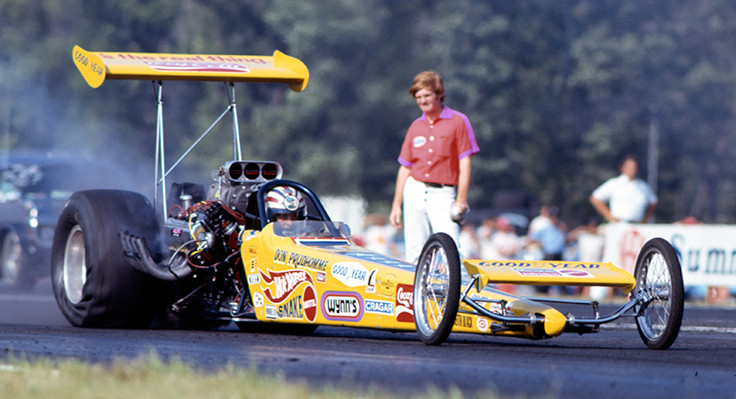
After giving up on the Hot Wheels wedge, Prudhomme brought out his famed “Yellow Feather,” a super-lightweight rear-engine dragster built by Kent Fuller that went on to set track records and go deep into elimination everywhere in 1972 but never won a national event.
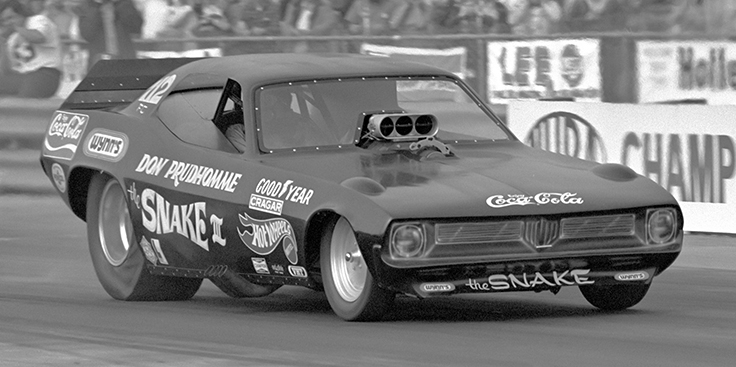
He only ran the yellow Snake II Barracuda Funny Car at match races and then switched to the revered stealth-black Snake III, which had minimal Hot Wheels branding as the deal was in its last days, at the year-ending Supernationals, where he qualified just 13th and was the first-round victim in what would go on to be Jim Dunn’s historic victory, the first (and still only) NHRA national event win in a rear-engine Funny Car.
By 1973, Hot Wheels was a small sticker above the front fenderwell of the yellow-again 'Cuda, now sponsored by Carefree Sugarless Gum, and would carry Prudhomme to his first Indy Funny Car win, making him the first driver to win the Big Go in both nitro classes. From Columbus on, Prudhomme was out of the Top Fuel business.
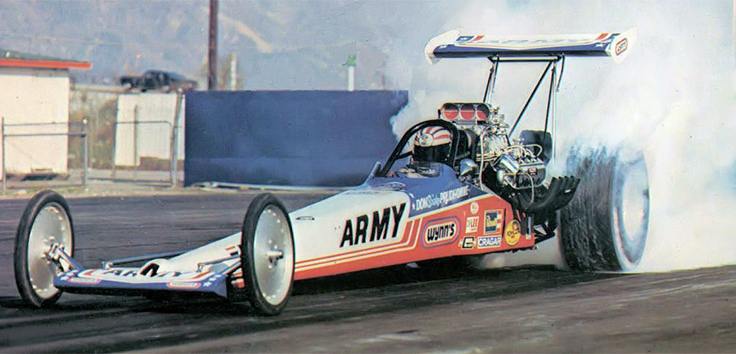
1974 was the start of Prudhomme’s long-running Army sponsorship and, other than a photo shoot of his Yellow Feather in Army colors at Irwindale Raceway for a plastic model box art (the car never publicly competed), Prudhomme didn’t get back into a Top Fuel car until 1990.
McEwen’s Garlits-built rear-engine car quickly carried him to victory at the 1972 March Meet. He beat Carl Olson in the final with a track record 6.35 and never ran slower than 6.44 during the five elimination rounds. He also went to the semifinals of the Gatornationals before losing to its builder, Garlits. Other than the Winternationals, McEwen did not run his Funny Car at a national event until the Supernationals, where, ironically, he went out in round one to Pat Foster, the losing half of that famous final round with Dunn. Like Prudhomme, after that McEwen became a Funny Car-only guy until the 1990s.
OK, Hot Wheels fans, that’s another mystery unraveled and decoded by the Dragster Insider. Thanks for reading along and, as always, for your input and encouragement.
(And, unlike the Hotel California, when you check out here, you can leave.)
Phil Burgess can be reached at pburgess@nhra.com
Hundreds of more articles like this can be found in the DRAGSTER INSIDER COLUMN ARCHIVE
Or try the Random Dragster Insider story generator