

Don Garlits and Darrell Gwynn; their lives in words and photos in new books

Random ramblings and rumblings, the sequel
Random ramblings and rumblings
Memories of Englishtown
Remembering Steve Ambrose
-
Right back where we started from: Winternationals is back at No. 1
Meet Larry Wood: The man whose designs launched a million hot rod dreams
Can you imagine a toymaker designing your Top Fueler? 'Snake' and 'Mongoose' could
For the love of old drag racing photos
The ultimate Funny Car winners quiz
Still popular after all these years: Catching up with fan favorites Eddie and Ercie Hill
Eddie Hill, the early years
55 years ago, Don Garlits forever changed the look, feel, and future of Top Fuel racing
On a roll: A look at some all-time great NHRA Drag Racing success streaks
NHRA's Top 75 Moments: Bernstein, 'Big,' and Shirley reflect on making history
- ad
Funny Car set to turn 1,000: A look back at the milestone races along the way
Beyond the Top 75s ...
Wait ... Jim Head was in a 1960s surf band promoted by a drag racing legend? Yep.
More Martin memories
The Popular Hot Rodding Championships put U.S. 131 in the national spotlight
Friends we lost in 2025
Re-telling NHRA history: The 75th anniversary book and other special projects
It was John Force's world, and we were all thrilled to be living in it
The Joyce of Drag Racing Photography
Two legends: 'Big' and Bakersfield
- ad
When did we start doing that? Tracking some of the biggest changes in our sport
From 10-time dominators to one-time winners, a history of Indy Top Fuel champs
Legend to legend: Don Prudhomme on Don Garlits, Indy, and other great takes
NHRA Rookies of the Year: A look back at where some fabulous careers began
NHRA national event history: A look at the tracks and stories that drove the sport
A Memorial Day salute to armed services sponsorships in NHRA history
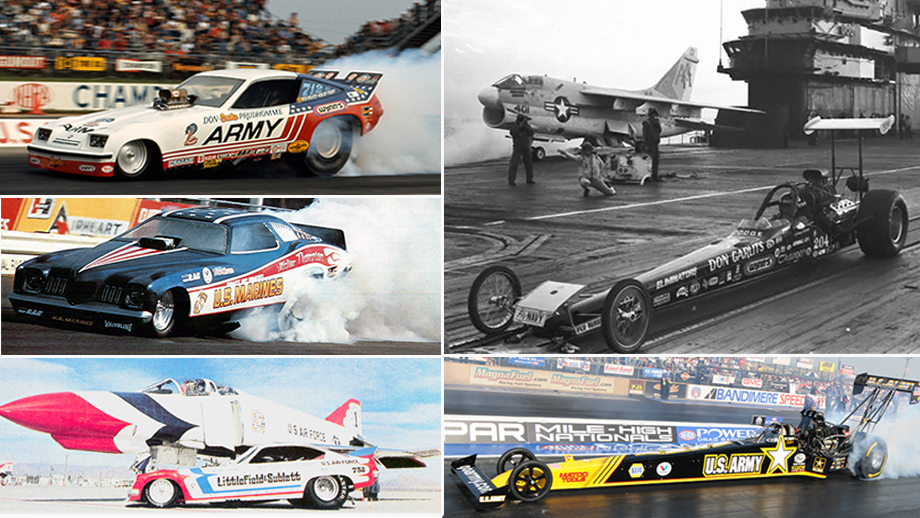
As we approach this Memorial Day weekend, where we pause to honor and remember military personnel who died in service to their country, I started thinking back about the many armed forces sponsorships we’ve seen over the last 50 years and thought it would be fun to document some of them.
U.S. ARMY
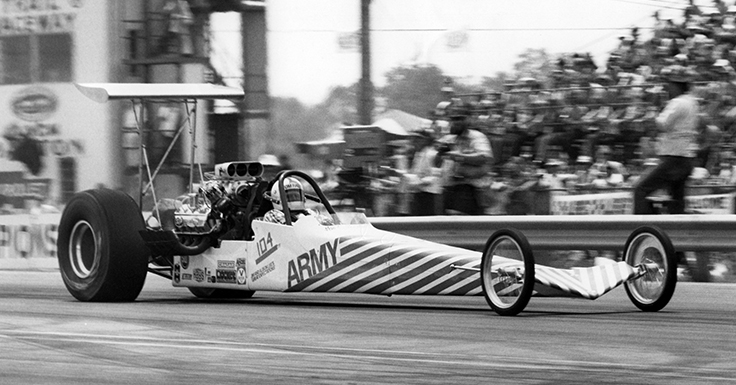
Two of drag racing’s most successful drivers, Don Prudhomme and Tony Schumacher, both flew the colors of the U.S. Army to great success, Prudhomme from 1974 through 1980 and Schumacher from 2008 to 2018, but the first “big deal” Army sponsorship was on Jim and Alison Lee’s dragster in 1973 with driver Tom Raley. Of course, the entire U.S. armed forces were struggling for enlistment following the Vietnam War, so their involvement in a sport that catered to red-blooded American males seemed a natural.
In the spring of 1973, Raley was involved in a two-car accident when the other driver rear-ended him in the shutdown area, destroying the car and sending Raley to the hospital with a tailbone injury and sidelining the car.
Enter Prudhomme.
Last year, “Snake” told me that he had once been at the same race with the Lees in 1973, and the Army motorsports liaison, Wes Wells, was so impressed with Prudhomme’s operation that they signed him up for 1974.
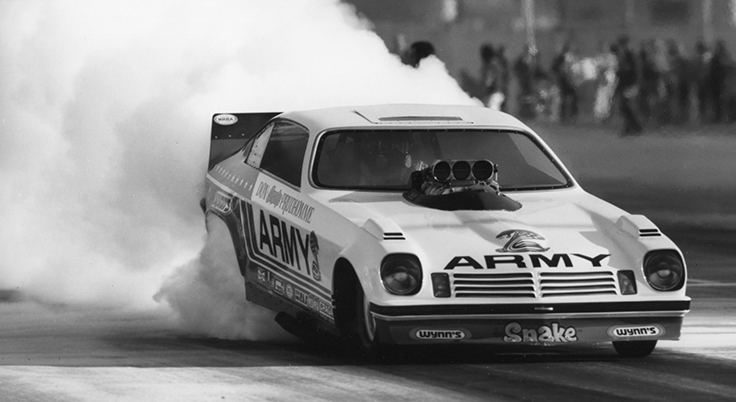
Prudhomme’s first official Army car, with an iconic paint scheme designed and applied by Kenny Youngblood, was the ill-fated, low-riding Vega that ran just two events — the AHRA Winternationals at Beeline Dragway in Arizona and the NHRA Winternationals in Pomona — before Prudhomme and crew chief Bob Brandt parked it after qualifying just 14th and losing in round one in Pomona. The car was deemed too heavy and hard to see out of (there actually was a slit cut in the roof hatch for him to see Christmas Trees that were suspended in the air), so they quickly reverted to their trusty 1973 Indy-winning Barracuda and reskinned it in the Army colors.
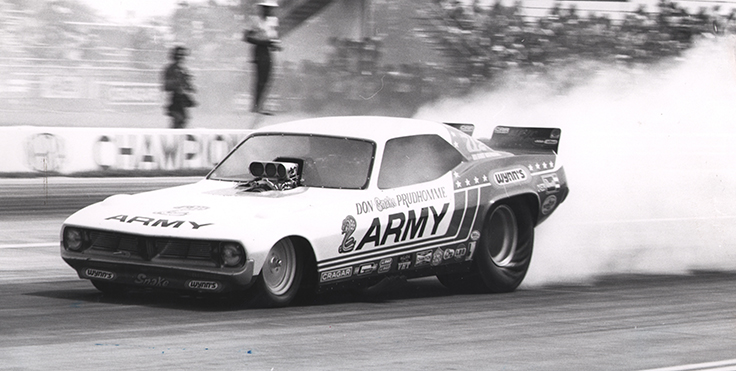
Prudhomme immediately won the NHRA Gatornationals in the car and won Indy again later that year, duplicating Ed McCulloch’s incredible back-to-back Big Go wins in 1971 and 1972.
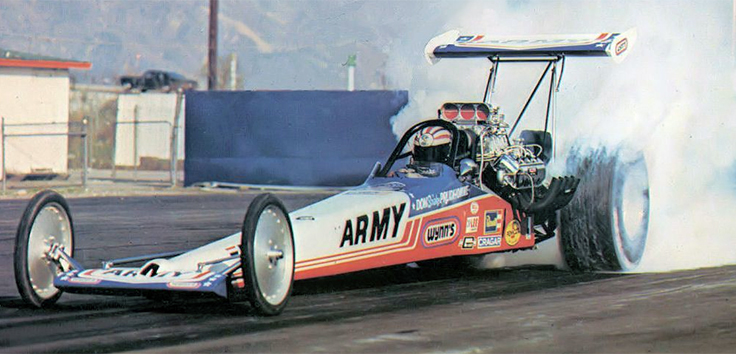
(I’d be remiss if I didn’t address this photo of a similarly skinned Army Top Fueler. Other than this publicity photo for a Revell model of the car shot at Irwindale Raceway, neither Prudhomme nor Brandt recalls ever running the car — which was 1971’s famed “Yellow Feather” dragster — in competition, which makes sense because by then “the Snake” had committed solely to Funny Car competition.)
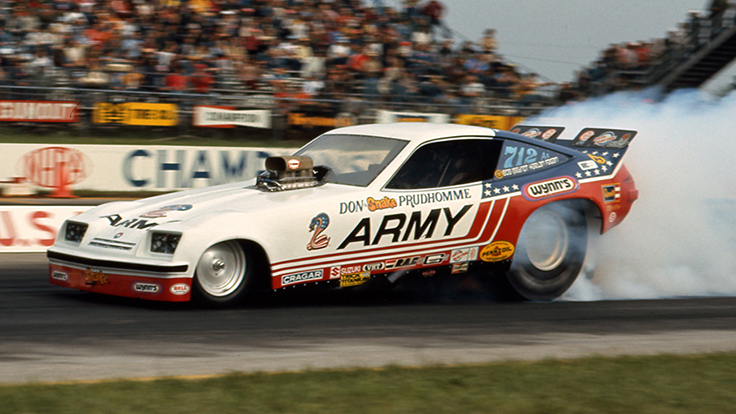
The 'Cuda gave way in 1975 to the all-conquering Jim Hume- and Pat Foster-built Army Monza that carried Prudhomme to 13 wins in 16 events and his first two championships in 1975 and 1976. Surprisingly, the only thing the Monza did not do was win the U.S. Nationals.
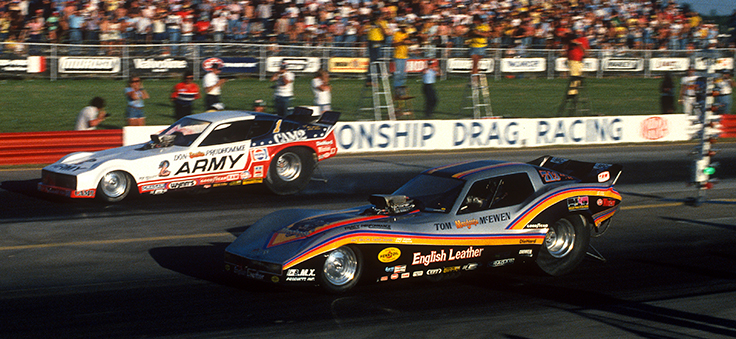
After Indy runner-ups in 1975 and 1976, Prudhomme won Indy again in 1977 in his Jaime Sarte-built Plymouth Arrow (beginning a new relationship with Chrysler) and his third championship then kicked off 1978 with his fourth straight Winternationals win and ended the year as champion again despite losing the memorable 1978 U.S. Nationals final to Tom McEwen.
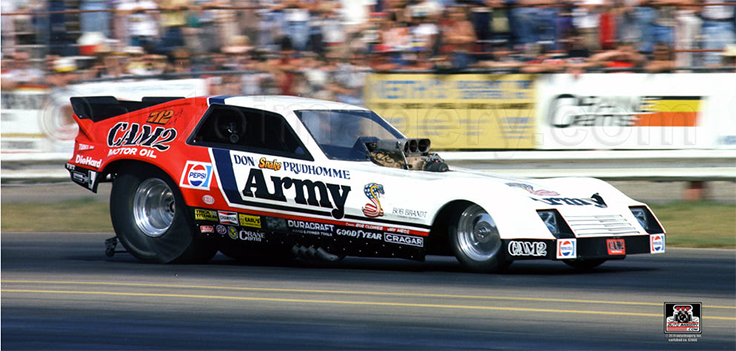
Prudhomme lost his championship to Beadle in 1979 after a disappointing one-win (Montreal) season with the Arrow, finishing second behind the Blue Max driver by about three rounds. “Snake” started 1980 still in the Arrow and won the Gatornationals for the fourth time in eight years before switching to a new Plymouth Horizon at Orange County International Raceway’s 64 Funny Cars show in April. Prudhomme won the Summernationals that year but little else and finished a distant sixth in points. That was the final year of the Army deal.
“It was a great, great partnership with them, and really worked out as a recruiting tool,” said Prudhomme. “I went to a lot of high schools with the recruiters to talk to kids about their future and had a good time. Those were some good years for us.”
It would be 19 years before Uncle Sam would come calling on NHRA again, tapping newly crowned 1999 world champ Tony Schumacher to fly the Army colors in 2000, kicking off at the U.S. Nationals what would be an 18-year run that would rival Kenny Bernstein’s Budweiser partnership and john Force’s Castrol deal in terms of longevity. Prudhomme said that the Army did have courtesy discussions with him before choosing Schumacher, but “the Snake” and Larry Dixon were happily in the middle of a 10-year partnership with Miller that would yield their first championship in 2002.
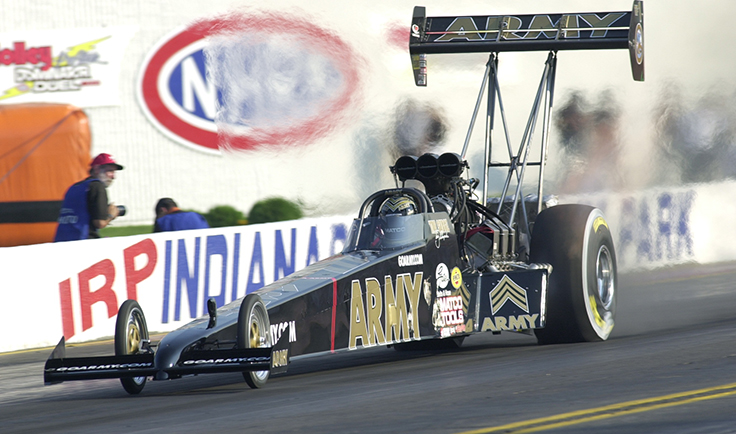
Like Prudhomme, Schumacher did the Army proud right away. Like “Snake,” he won the U.S Nationals in his first year, but he also played the role to the hilt, getting a military crewcut and adopting the nickname “the Sarge.”
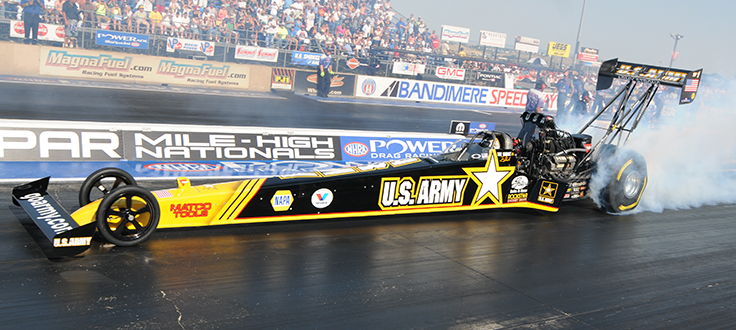
After winning 10 races in the first four years with the Army, Schumacher matched that total in one year, 2004, when he claimed his first of what would be six straight world championships. Two years later, he and crew chief Alan Johnson made “The Run,” perhaps the most amazing championship-clinching run in NHRA history, and two years after that had the single-best nitro season (by volume) with 15 wins in 24 races in 2008.
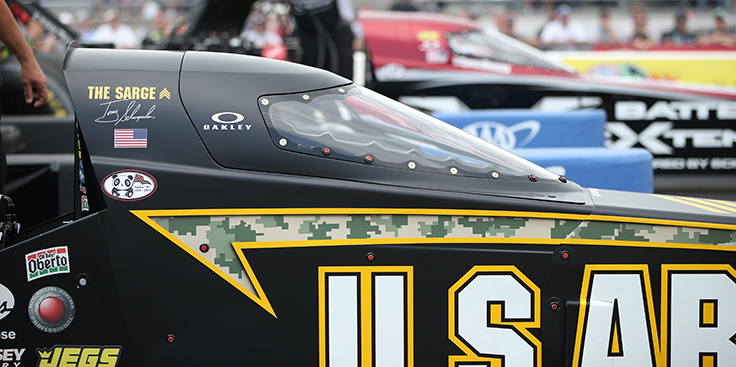
In 2013, the team introduced the first modern canopied dragster, and in 2014 won his eighth and most recent world championship. The Army deal ended at the end of 2018, by which time he had won 83 national events in the black and gold colors.
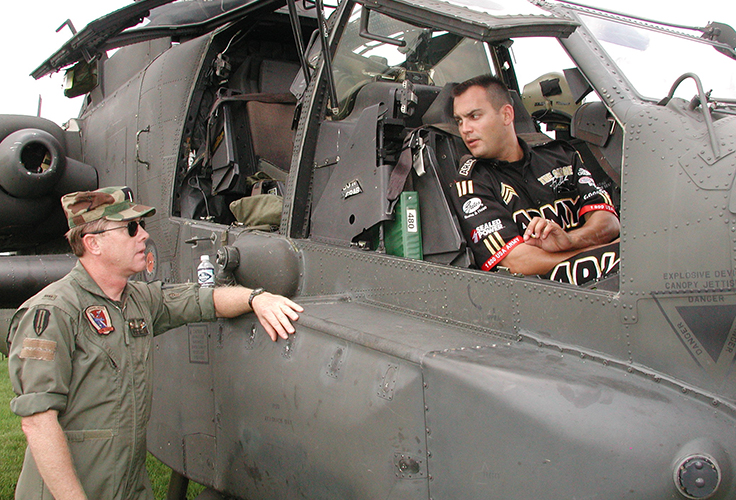
Schumacher was front and center a lot for the Army at many special occasions over nearly two decades, visiting bases at home and abroad, going to boot camp, and even trying out the seats of tanks and helicopters.
The late Don Schumacher, who was inducted into the Motorsports Hall of Fame of America during that 2018 season, reflected, “The U.S. Army has been a great partner of Don Schumacher Racing for nearly two decades, has been a mutually beneficial relationship with the U.S. Army instilling the mental, physical, and emotional strength of the U.S. Army Soldier in all of us. We remain extremely proud of our representation of the U.S. Army.”
U.S. NAVY
“Big Daddy” Don Garlits and the U.S. Navy were partners for more than decade, beginning in the early 1970s through the mid-1980s in which Garlits promoted Navy enlistment in everything from television commercials to well-publicized photo shoots with his Swamp Rat dragsters on the decks of Navy aircraft carriers.
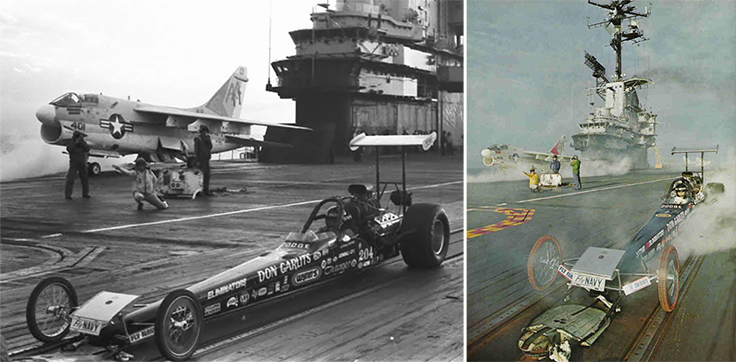
The first was in 1972 with Swamp Rat 16 — the follow-up to Swamp Rat 14, his class-changing first rear-engine car (Swamp Rat 15 was a traditional slingshot built as a hedge in case SR14 didn’t live up to Garlits’ expectations) — aboard the USS Lexington in 1972 that was turned into a "Fly Navy" recruiting poster with “Big” appearing to "race" an A-7E Corsair II.
Garlits’ entire rig — truck and trailer — were hoisted aboard the Lexington in Pensacola, Fla., which put out to sea in the Gulf of Mexico for five days of maneuvers with “Big Daddy,” crew chief T.C. Lemmons, and Hot Rod magazine photographer Mike Brennan on board. What was not allowed to be brought on board was any nitromethane fuel, and the idea was to shoot some static photos alongside the plane.
As Garlits recounts in his book, Don Garlits and His Cars, “All of a sudden it was decided that the engine in the Swamp Rat should be running, but we had no fuel! What was on board that we could use? Someone said there was lots of ethanol in the dispensary, and someone went to get a couple of gallons. The dragster fired up just fine on this strange type of alky. Then the sun wasn't shining in the right direction, so Mike told the captain to turn the carrier just a little, but then it was too much, so he asked if he would move the carrier back the other way just a little. The captain was sure glad to see us all leave without an incident, as he was retiring in a couple of months and didn't want any blemishes on his record.”
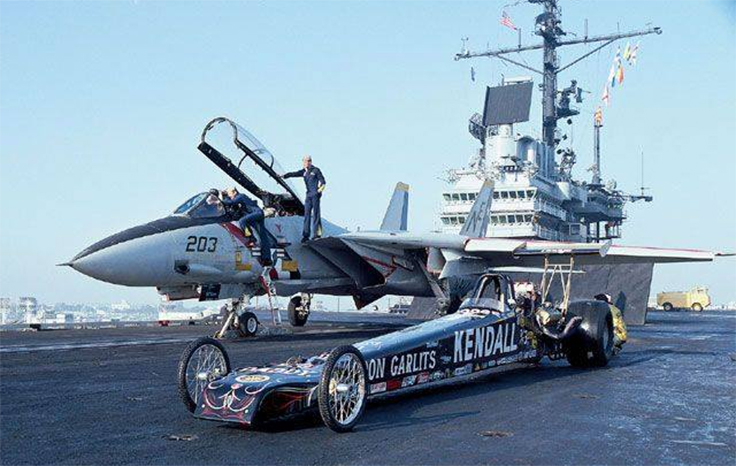
In March 1980, not long after failing to qualify at the Winternationals, Garlits took his Swamp Rat 25 — an overly heavy, underperforming beast that he and crew chief Herb Parks had taken to calling “Godzilla” — onto the flight deck of the USS Ranger, which was docked in the San Diego harbor, for “a burnout photo.” Former Hot Rod editor David Freiburger later reported that after looking through the photo archives, there wasn’t a real burnout: “A smoke bomb and some sketchy photo retouching made it look legit,” he wrote, but the poster sure looked great.
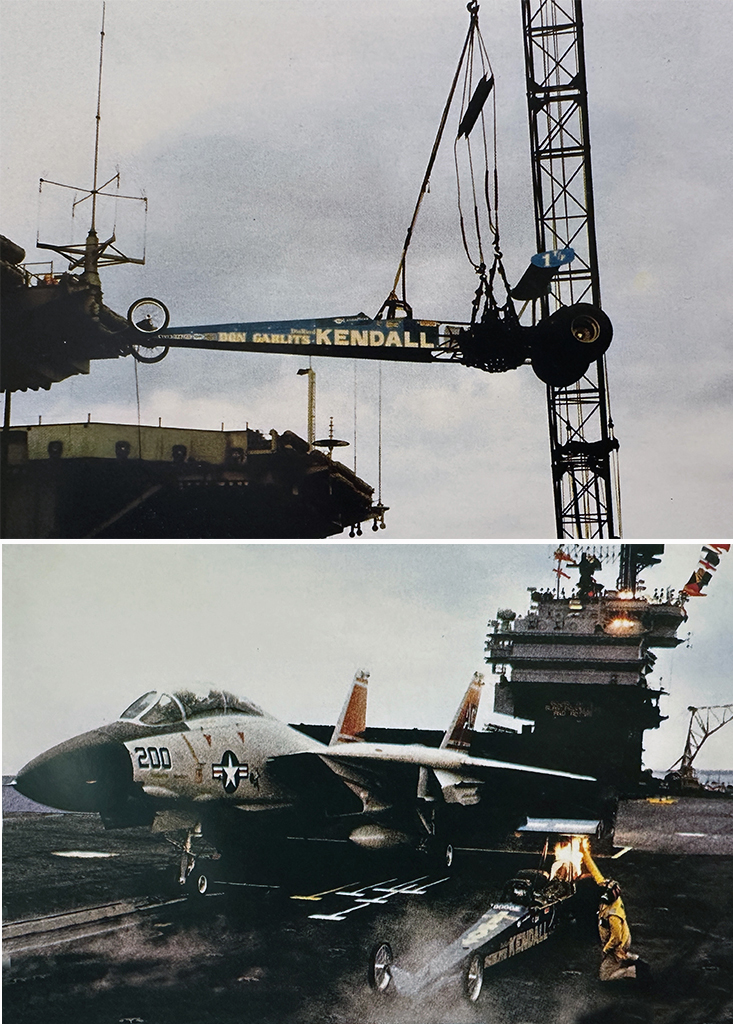
In September 1983, the Navy hoisted Garlits’ wildly imaginative but equally unsuccessful Swamp Rat 28-B turbine-powered car aboard the USS John F. Kennedy for another photo shoot, this time alongside an F14-A Tomcat. The T85 engine in the dragster had been transplanted from a Navy helicopter, making for a major cross-promotion opportunity. Garlits and jet-car pioneer Craig Arfons even rigged a little flame show afterburner behind the car for a little more sizzle.
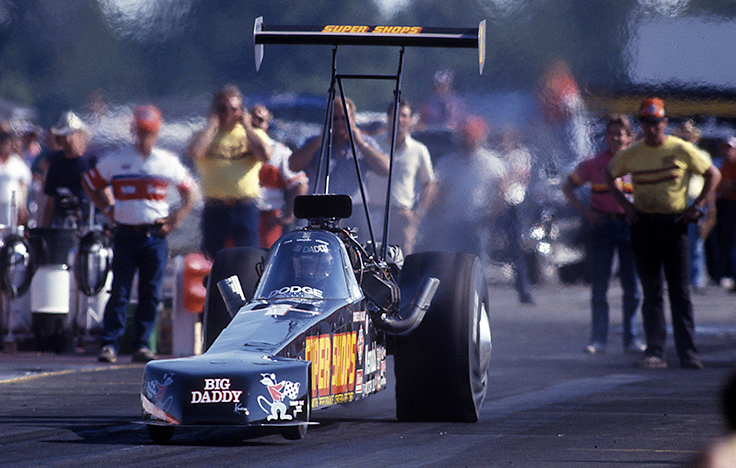
No longer content to fake a race against the Navy’s best — which, of course, was impractical considering the length of the carrier decks — Garlits schemed to take on the Navy on the ground at New Jersey's Lakehurst Naval Air Station in September 1986, just a week after Garlits won the U.S. Nationals for the eighth and final time.
Garlits’ weapon of choice was his famed Swamp Rat XXX streamliner — the first to crush the 270-mph barrier earlier that year — while the Navy brought a Navy F/A-19 Hornet Strike fighter. The Navy’s Tom Hall, who had arranged Garlits’ 1972 photo visit aboard the Lexington, was still around to make this race happen.
It wasn’t the first time that this kind of race had been staged. In 1975, Tom McEwen, who had been helping the Navy with recruitment starting the year before, scheduled a “race” against a Navy F-14 Tomcat at Patuxent River Naval Air Station on Chesapeake Bay in Maryland for a Hot Rod magazine cover story. The interesting tie-in here was that McEwen’s father had been a naval aviator who died in a plane crash while “the Mongoose” was very young.
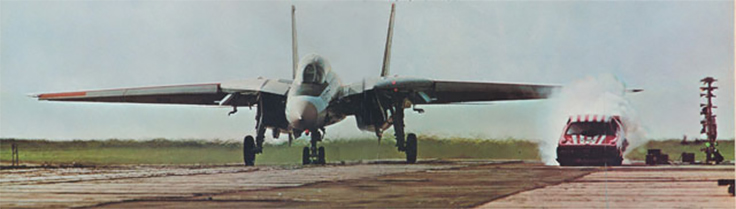
Unfortunately for “the ‘Goose,” his own car was damaged the week before when it was struck in the shutdown area by Kenny Safford’s crew vehicle at U.S. 30 Dragway, so McEwen called in teammate John Collins’ matching Duster.
In this case (and I’m assuming it was the same for Garlits nine years later), the plane was being launched via a steam catapult versus a pure jet-assisted takeoff. The fighter plane covered the 258-foot “course” (the point where the jet’s front wheel left the ground) in 1.76 seconds at 175.86 mph. With no traction purchase on the runway, Collins and the team took their Duster to nearby Capitol Raceway, where his best pass over the same distance was 1.97 at 118.20 mph. As the Hot Rod story summarized, “It was clear that [Collins] was racing the catapult and not the jet.”
But back to 1986. According to Hot Rod, NHRA timing system expert Art Hayward and even Chief Starter Buster Couch were brought in to set up the timing system for a 300-foot race.
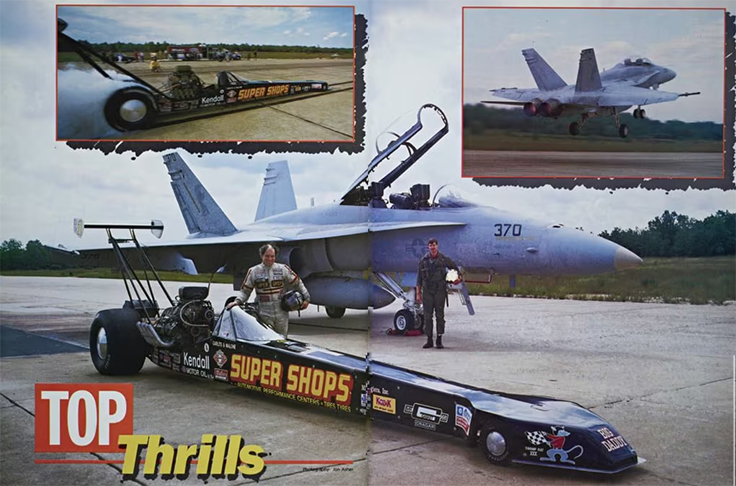
Even with Hot Rod publisher “Hand Grenade Harry” Hibler riding in the back seat of the jet, it crossed the timers in 2.39 seconds.
Garlits and crew chief Herb Parks surveyed the concrete runway and coated it in traction compound. Garlits launched hard and smoked the tires, but still ran 2.66. A second tire smoker followed, and the decision was made to put the contestants on more equal footing. A week later, Hayward set up a 300-foot timer at the NHRA Keystone Nationals at Maple Grove Raceway, and Garlits crushed it with a 2.29-second clocking.
U.S. MARINES
The Marines joined the party in 1975, coming aboard to sponsor Mickey Thompson’s Grand Am Funny Car, with incoming driver Larry Arnold enlisting the Corps.
“Mickey was not interested in putting money into drag racing, so we talked about putting someone else's money in to pay for the car,” Arnold told me years ago. “I had been thinking the Marines would be a perfect sponsor; going head-to-head with the Army would be a great draw. When contacted, the Marines agreed.”
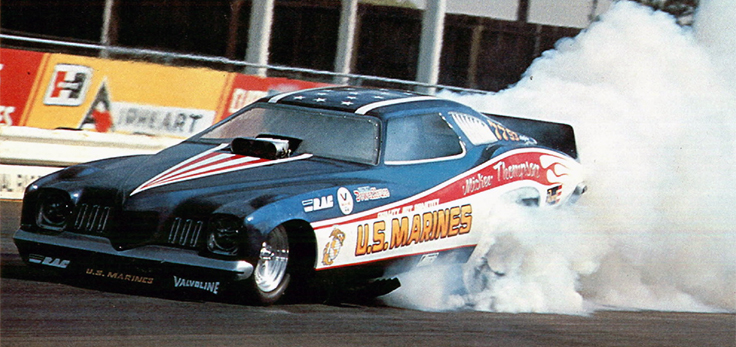
Unfortunately for Arnold, during this photo shoot at Orange County International Raceway, the engine burned a piston and the car caught fire, sending him to the burn ward. Charlie Therwanger subbed for him at the Winternationals, where he reached the semifinals before losing an armed-forces clash with Prudhomme’s new Army Monza. Arnold was back in the car for the Gatornationals, where he qualified fifth but lost in round one. He also ran a couple of match races with the car before he, like previous driver Dale Pulde, decided he didn’t like the business arrangement with Thompson and handed the car back to MT.
SoCal racing veteran Bob Pickett picked up the ball and ran with it, and had more success. He didn’t qualify in his national event debut at the Springnationals but reached the semifinals of both Le Grandnational and the U.S. Nationals, losing to Prudhomme’s Army car on both occasions.
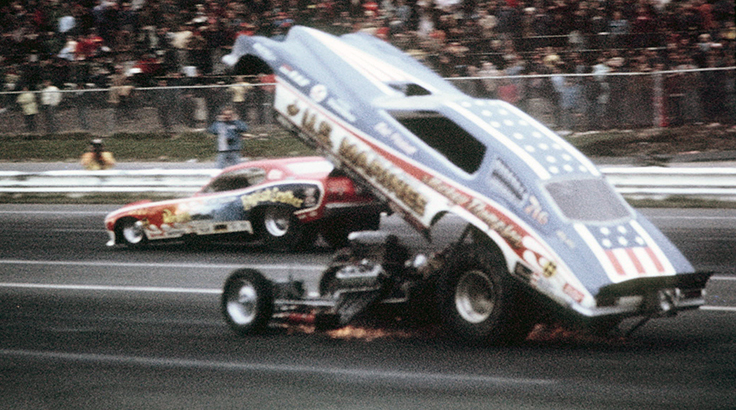
Between, he had his fair share of moments, including a memorable body unlatching after a wheelstand in the final round of the 1975 Northwest National Open in Seattle against Ed McCulloch as shown in this memorable Al Kean photo.
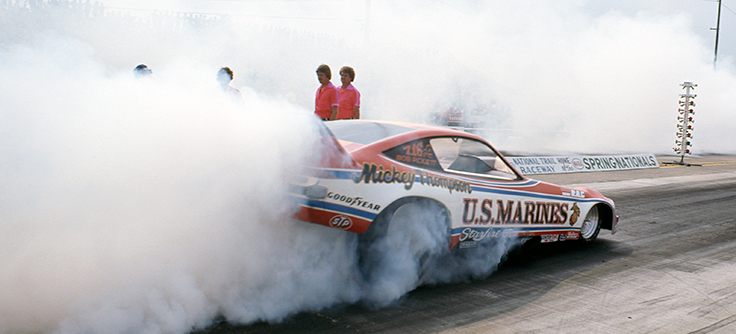
After a trying 1976 season in which Pickett crashed the car in Arizona, the car was pretty much worn out, the body was dated, and Thompson was growing ever more disinterested in drag racing. The car was retired at the end of the season, and the Grand Am shell replaced with a new U.S. Marines Starfire, in which Pickett won the Springnationals to give the service branch its only NHRA national event win.
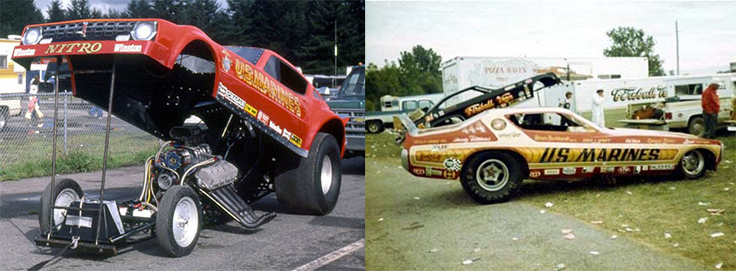
According to our friends at DragList.com, Northwest racer "Nitro Nick" Harmon (above left) also has Marines backing for a short time on his Arrow Funny Car as did Texas racer Jim Harrison and driver Bruce Burkhart (above right). According to the story, it looks like Harrison's backing may have been local and he had to stop because Thompson had an exclusive on the sponsorship. Thanks to Kean for pointing this out.
AIR FORCE
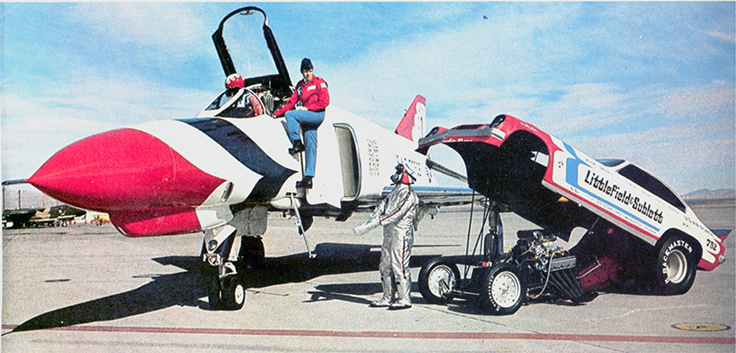
Mert Littlefield and Marty Sublett landed an Air Force sponsorship for their Vega Funny Car in 1974 and had the requisite photo shoot, this one at Southern California’s March Air Force base, shot by Jon Asher for the April 1974 issue of Car Craft.
It was a pretty good year for Littlefield, who finished second in Division 7 and used the proceeds of that season and the sale of this car (to Tom Ridings, which became his first BB/FC) to buy the business that would become Littlefield Blowers.
Mert’s son, my longtime former ND colleague Brad, shared this funny story: "This was before Dad bought the blower business – he had been running Danekas blowers – and, ironically, he didn’t have a blower for the photo shoot, so he borrowed one from Joe Paisano. There’s a burnout photo that was caught right in the nick of time, because right after that, it backfired.”
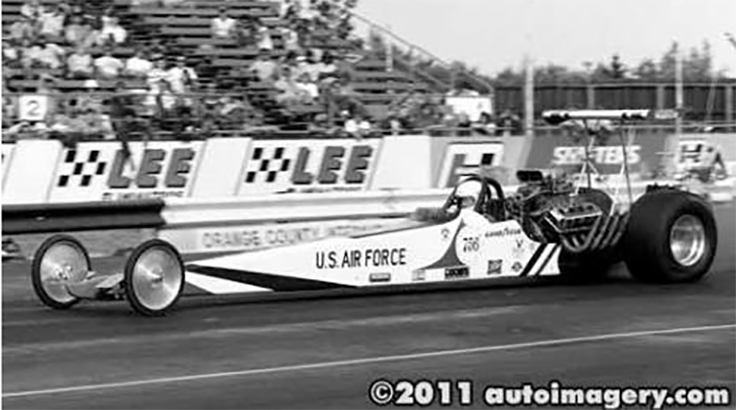
Top Fuel racer Bob Bommarito, who was based in Long Beach, Calif., had U.S. Air Force backing that same year as a quasi-teammate to Littlefield.
"I was just one of many little guys that tried our best," he told me way back in 2009 in the early days of this column. "I never had any money and only had a sponsor for one full season. The Air Force [sponsorship] was more of a display and working with recruiting than a money deal. We ran mostly local, and never won, but had a lot of fun back in the day when you ran a Top Fuel car out of your garage.”
According to Insider reader Kevin Bench, who worked for Bommarito, he and Littlefield were friends before the USAF deal, and Bommarito was also a customer of Littlefield Blowers, but they were never actually teammates. According to Bench, as Littlefield’s blower business began to consume more time than racing, Littlefied recommended Bommarito to the USAF marketing team, and Bench ended up working for Littlefield doing machine work.
So, there you have it, a look back at some memorable cars backed by the U.S. military over the years. As we remember our fallen heroes, we also remember these great cars, just another interesting chapter in the near-75-year history of the NHRA.
Phil Burgess can be reached at pburgess@nhra.com
Hundreds of more articles like this can be found in the DRAGSTER INSIDER COLUMN ARCHIVE
Or try the Random Dragster Insider story generator