

The early Hart of the NHRA
Don Garlits and Darrell Gwynn; their lives in words and photos in new books

Random ramblings and rumblings, the sequel
Random ramblings and rumblings
Memories of Englishtown
-
Remembering Steve Ambrose
Right back where we started from: Winternationals is back at No. 1
Meet Larry Wood: The man whose designs launched a million hot rod dreams
Can you imagine a toymaker designing your Top Fueler? 'Snake' and 'Mongoose' could
For the love of old drag racing photos
The ultimate Funny Car winners quiz
Still popular after all these years: Catching up with fan favorites Eddie and Ercie Hill
Eddie Hill, the early years
55 years ago, Don Garlits forever changed the look, feel, and future of Top Fuel racing
On a roll: A look at some all-time great NHRA Drag Racing success streaks
- ad
NHRA's Top 75 Moments: Bernstein, 'Big,' and Shirley reflect on making history
Funny Car set to turn 1,000: A look back at the milestone races along the way
Beyond the Top 75s ...
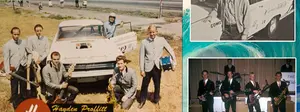
Wait ... Jim Head was in a 1960s surf band promoted by a drag racing legend? Yep.
More Martin memories
The Popular Hot Rodding Championships put U.S. 131 in the national spotlight
Friends we lost in 2025
Re-telling NHRA history: The 75th anniversary book and other special projects
It was John Force's world, and we were all thrilled to be living in it
The Joyce of Drag Racing Photography
- ad
Two legends: 'Big' and Bakersfield
When did we start doing that? Tracking some of the biggest changes in our sport
From 10-time dominators to one-time winners, a history of Indy Top Fuel champs
Legend to legend: Don Prudhomme on Don Garlits, Indy, and other great takes
NHRA Rookies of the Year: A look back at where some fabulous careers began
NHRA's Top 75 Moments: Bernstein, 'Big,' and Shirley reflect on making history
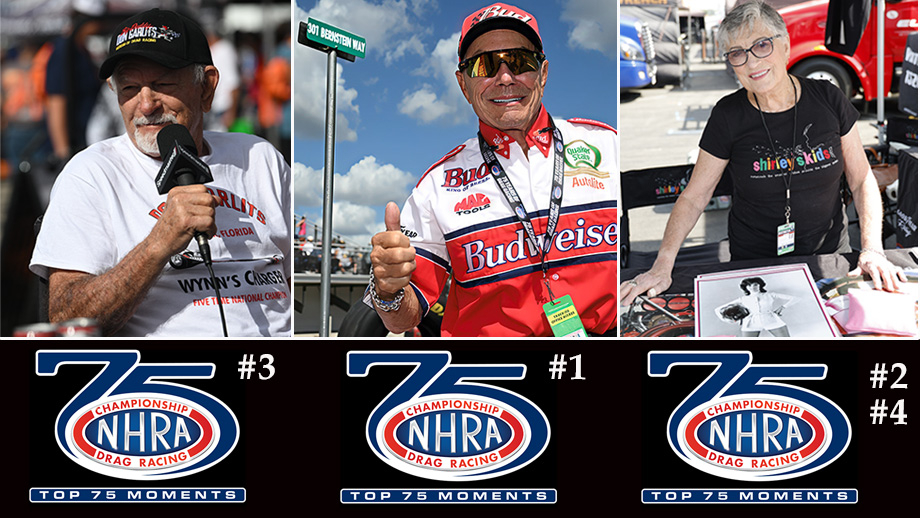
The announcement last week that Kenny Bernstein's barrier-breaking 300-mph pass at the 1992 NHRA Gatornationals was the number one fan-voted moment in the 75-year history of the NHRA wrapped up NHRA's Top 75 Moments, one of the most ambitious projects that I've taken part in over my 44 years of slinging words here at NHRA.
Bernstein's shot heard ‘round the world certainly had all the hallmarks of being worthy of that prestigious honor and certainly battled a number of other unforgettable moments in NHRA history to top the list.
Bernstein's 300-mph run edged out Shirley Muldowney's first Top Fuel world championship (1977), the first ever by a woman, and Muldowney's first Top Fuel win at the 1976 NHRA Springnationals, which was the first Pro win ever by a female racer, both of which sandwiched nicely around Don Garlits’ 1971 NHRA Winternationals win with the rear-engine dragster that transformed the class.
Interestingly, the first four fan-voted moments are all based around the Top Fuel class, showing that nitro-powered dragsters are still, in many ways, the kings of the sport, whether it's on the scoreboard or in the minds and memories of our fans.
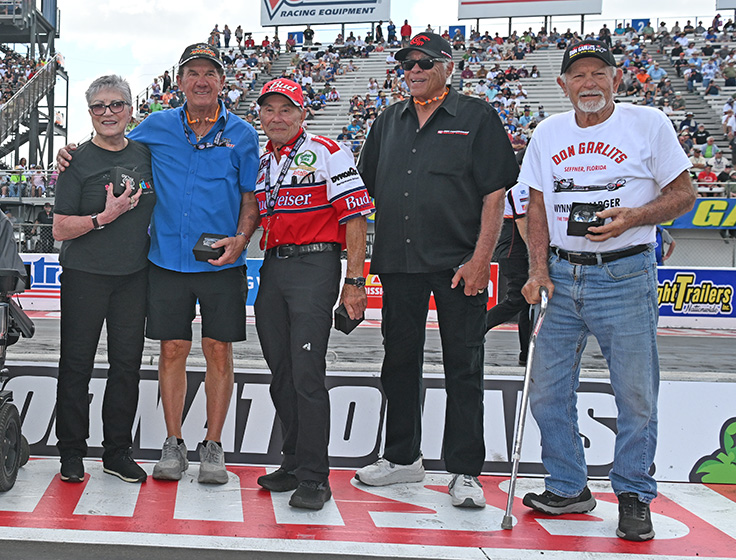
I got the chance to talk to all three protagonists of those moments — Bernstein, Garlits, and Muldowney, who were all part of the first Legends tour at the Gatornationals — over the last week to get their reactions to their contributions to the sport being so fondly and highly remembered by the fans.
I was a little surprised that Bernstein's 300-mph run was a clear winner in the category. There were so many other great moments — including the other three that I mentioned here — that Bernstein's barrier breaker triumphed over, even though there are others — many others — who will say that their favorite moment or the moment they thought was the biggest of the sport didn't even crack the Top 10. Ah, the beauty of the public forum.
To backtrack a little bit, the project began last year when, using my vast knowledge of the sport as both a fan and a reporter, I handpicked 100 of what I thought were the greatest moments in the sport's history going all the way back to 1951 and put them into a ballot for the fans to vote on, asking them to pick 75 of the 100. From there, it was a simple matter of waiting several weeks of watching the ballots flood in and then just looking at which ones got the highest votes and ranking them from that, but it only took a day or two to see that Bernstein’s moment was the runaway leader, and only expanded that lead as more and more votes came in.
So, let's start with a quick recap of those four moments and hear from the people who made them happen, with links to the stories I wrote about each of them. After that, we'll take a look at my Top 10 picks and how they differ from the fan votes and perhaps why. OK, let's get into it with the “King of Speed,” “Big Daddy,” and the ever-irrepressible Ms. Muldowney.
1. Kenny Bernstein’s 300-mph run
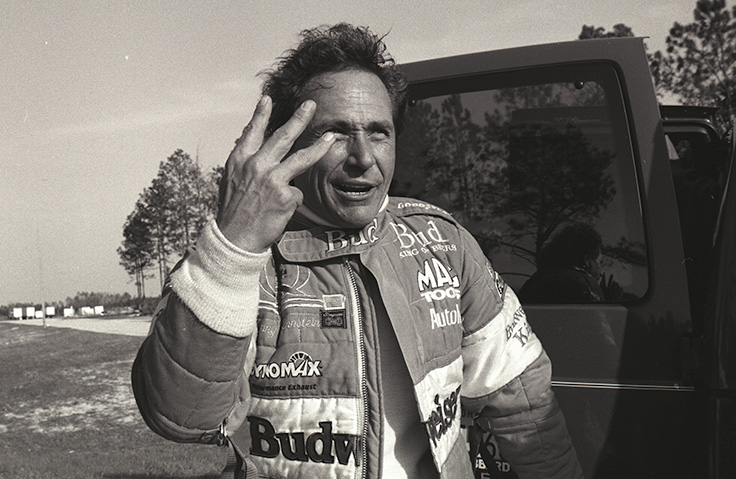
I think there was so much attention around it at the time because it was the last big barrier (in the hundreds category, at least) that we’ll ever see. It took nearly 30 years to go from 200 mph to 300 mph, and even though Top Fuelers are now regularly hitting 340, I don’t think we’ll see — or even want to see — 400 mph on the dragstrip in our lifetimes.
As you can read in the story I wrote (linked above in the headline), there was quite a media blitz — we did a whole section in NHRA National Dragster earlier that year called “Target 300” because the handwriting was on the wall that it was going to happen sooner rather than later — and, as Bernstein told it then (and tells it still now), they had no idea they were going to do it on that day, and crew chief Dale Armstrong actually turned away after being pleased with the 4.82 on the top half of the scoreboard and did not see the 301.70 on the bottom half until his crew spun him around and showed him.
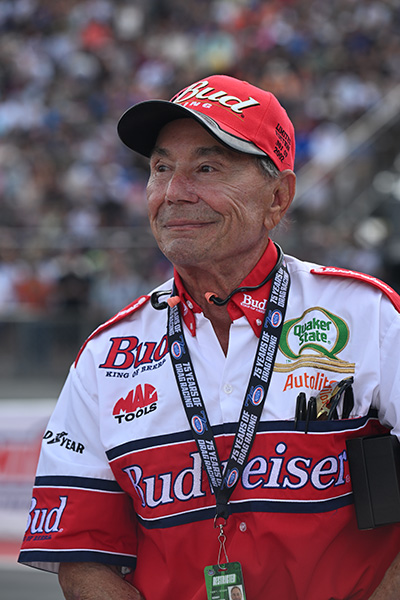
As I prepared to post the story on NHRA.com last Wednesday announcing it as the top moment, I called Bernstein to congratulate him on the achievement, and he was overcome by the honor, which touched me deeply. After all, this is a man who has known such great success in life, let alone racing, and the fact that y’all recognized this for the great moment that it is really reverberated in his soul. Kenny is and always has been a cool customer, but I could hear the breaking in his voice as he reflected on it and his late partner in history, Dale Armstrong.
"Thank you so very much. That's fantastic; it really means a lot to me,” he said. “My goodness, thanks to the fans. That's really great for Dale and everybody. I just appreciative it tremendously. It just means a lot to me and to [wife] Cheryl and certainly all the guys who participated with that. It's a great honor. I mean, the top moment of 75 years? Think about that. My goodness me, that's something very special. That's probably top of the list right now for me.”
I asked him how often he thinks about that moment 34 years ago.
“It actually comes up quite a bit, because wherever I go, where people who have any idea who I am, they always talk about that first,” he said. “A couple of days ago, we were playing golf with some guys, and one guy said, ‘You were the first one to go 300, right?’ so it's something that comes up quite often, more so than I would have ever thought. And again, it's just a great honor. I can't thank enough Armstrong and Wes Cerny and the guys that worked on the car all the time and got it done.”
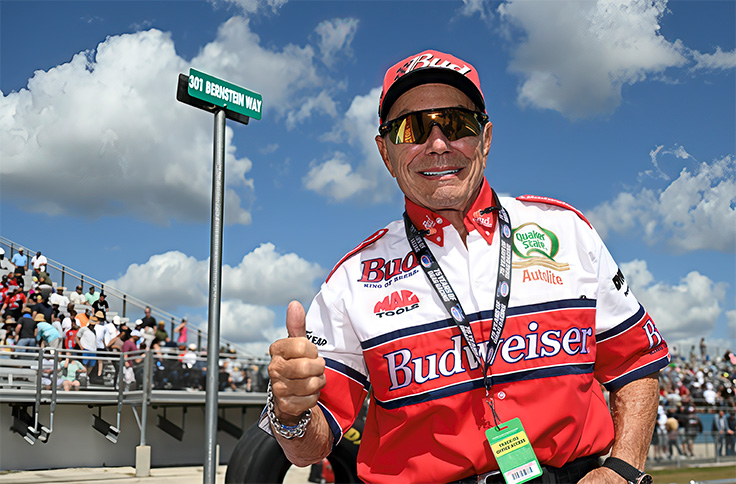
Bernstein was saluted in Gainesville, where the racetrack itself is named after him, and posed for us for this photo. If he gets tired of telling the story about that moment, it surely doesn’t show.
Bernstein’s name appears again on the Top 75 Moments list for being the first to win world championships in both nitro classes (No. 20).
2. Shirley Muldowney, first female NHRA champ
4. Shirley Muldowney, first female Pro winner
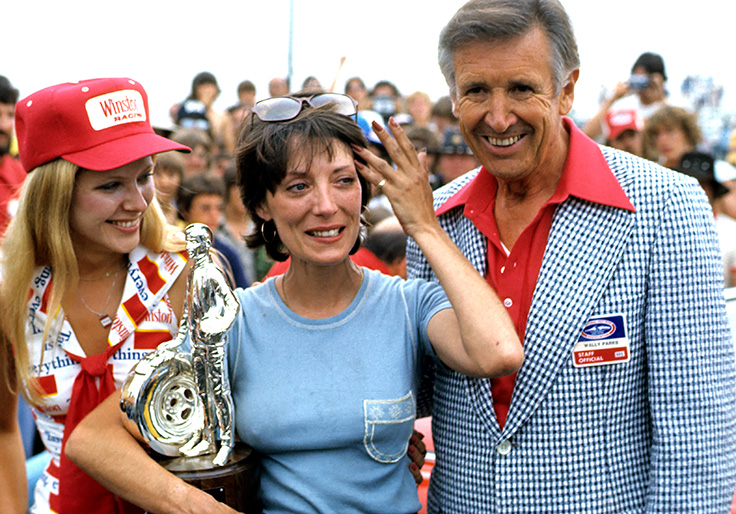
Muldowney’s dual gender-barrier-breaking accomplishments helped drive the sport’s popularity in so many ways — some definable, others not — that it certainly deserves a high ranking. The fact that she laid the ground for the Brittany Forces and Erica Enders and, now, Ida Zetterströms and Julie Nataas and Maddi Gordons of the sport to realize they had a place in this macho-born sport not only helped shape the incredible legacy of diversity but also brought in a female fan and racer base, and a family vibe. Suddenly, women who might have begrudgingly watched their husbands pull out of the driveway to go to the races now were climbing into the car with them.
Towards the end of the wonderful Shirley documentary of her life [you can watch it here on YouTube], Muldowney says plainly that she’s glad it was she who had to fight those battles because she had the toughness and the resilience, hewn from a rough family upbringing and a marriage splintered by differing priorities, to deal with the resistance she faced, to “not run from a fight.”
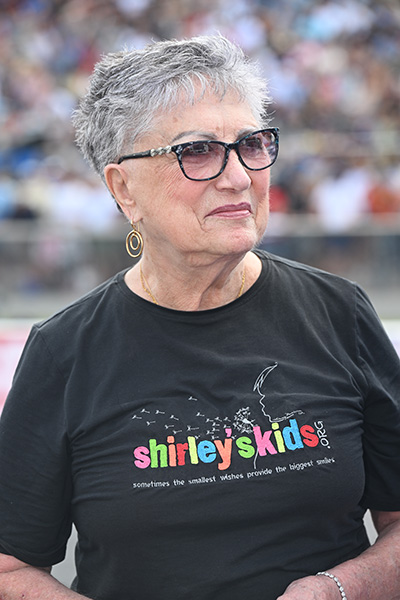
“For the sport's sake, I'm glad it was me, because I didn't give them even one chance to discount me,” she said. “I was there, and I wasn't going anywhere.”
Not that her nitro contemporaries like Paula Murphy and Della Woods also didn’t have moxie, but Shirley was clearly the right person for this fight, and the one to power through it, and single-mindedly pursue, catch, and surpass her dreams.
When we sat down in the Gainesville media center to talk about her having two of the Top 5 moments, she was thrilled with the realization.
“When I was first looking at the list, I didn’t really realize what I was reading, then I read it a second time, and I was, like, ‘Holy mackerel. That’s incredible.’ I’m very proud of all I was able to do, but if I hadn’t thought I could make it, I never would have made it.
“I went to a tough school downtown, and I used to get chased home. Finally, I stopped running. I was just a skinny little kid. I didn't weigh anything, but I stopped running, and I turned around and said, ‘You know, I can't beat all of you, but I'll take you one at a time.’ It was beat or get beaten.
“But it seems like my whole racing career went by so fast. It’s like it was just yesterday, and I’m very sad it’s over. I miss it every day.”
Muldowney was also part of other moments on the Top 75 list, including beating Connie Kalitta in the 1982 Indy Top Fuel final (No. 44), being the winning half of the first all-female Top Fuel final at the 1982 Springnationals (No. 58), and her terrible Montreal crash in 1984 (No. 75).
3. Don Garlits wins in a rear-engine dragster
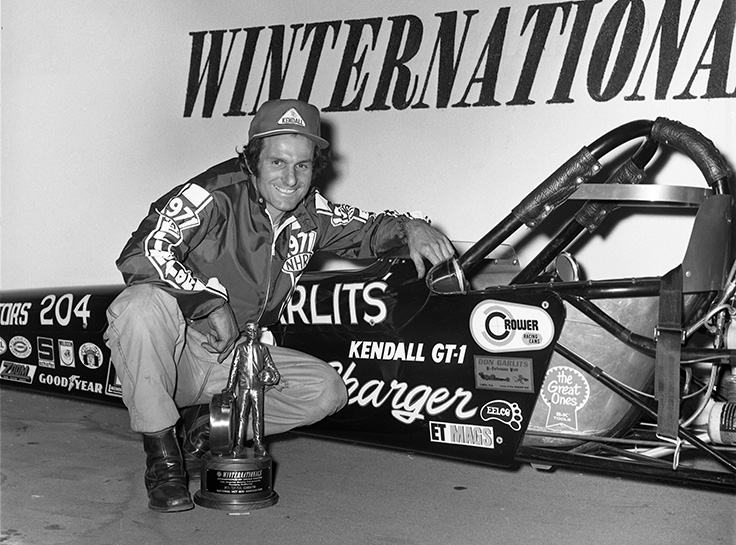
The fact that 55 years later, Top Fuel cars are still running the same basic configuration that Garlits perfected ahead of the 1971 season gives this one all of the credit it needs. Sure, Top Fuel cars have been lengthened, aerodynamically improved, and the powertrains put out six times the horsepower of a 1971 engine, but it’s still the same paradigm. People had tried it before Garlits, but few succeeded, and none as much as Garlits did with Swamp Rat 14.
Any chat with Don Garlits is a memorable one, and he never ceases to amaze me with his observations and memories. As much as I think I know about this man’s career, he always surprises me, and he did this time, too, and we reflected on the fan vote.
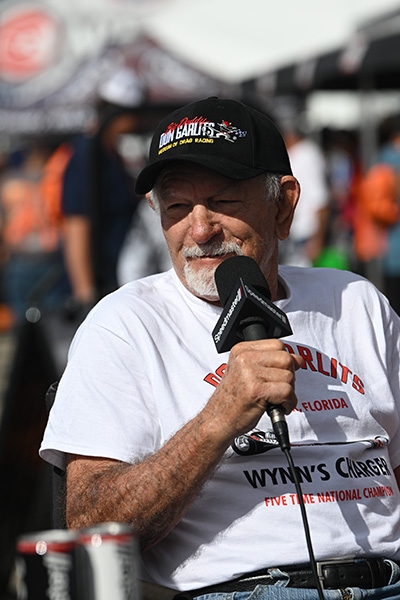
“It wasn't just a big moment in NHRA history. I would say it was one of the biggest moments in drag racing, just for the fact that the lives that it saved, including my own,” he said. "These cars haven't killed as many people in the last 50 years as they killed in the five years before [Swamp Rat 14].”
Then he said some things that dropped my jaw.
“I look at it all and reflect on everything, and I think it's the biggest accomplishment for Don Garlits — not the championships, not all the speed records, but the fact that I introduced something that we don't even know how many lives it saved,” he said. “What probably really would have happened, in all fairness, is that NHRA would have outlawed the class."
I don’t know that NHRA would have dropped the class, but when you look at that roll call of sadness — Pete Sorokin, John Mulligan, Pete Robinson, and many more — who died in the mid- to late 1960s in front-engine cars, you get where he’s coming from.
“Pete Robinson, we were close like brothers,” he continued. “It’s bringing tears to my eyes right now talking about it. He was the one I was closest to, because he's right up here in Georgia; he was a country boy, and we really communicated. And John Mulligan saved my career at the New York National Speedway in 1969. I was trying to run Valvoline oil, and I'd blown up everything I owned. I was out of money. I was out of engines. Back then, Valvoline was fine for your passenger car; it just wasn't a good oil for nitromethane.
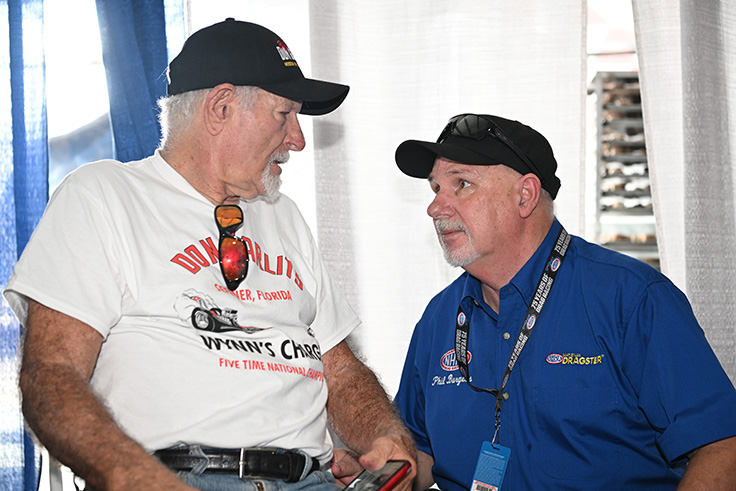
“I was under the car working on it, and he came up and said, ‘What’s going on, Big?’ and I showed him a rod bearing that was black. He said, ‘I'll be right back. Don't go anywhere,’ and came back with a case of Kendall 70 weight, and I never had any more trouble, and I won the event with the old-ass engine I had in the car.”
And that began Garlits' long association with Kendall Oil, which rode on his cars for decades to come and with him to other great moments.
Not unexpectedly, Garlits’ name appears six more times on the Top 75 Moments list, for breaking the 200-mph barrier in 1964 (No. 8), for his incredible 5.63, 250.69-mph run in Ontario in 1975 (No. 13), for winning the first Top Fuel race at the 1963 Winternationals (No. 24), for his unforgettable 1986 Englishtown blowover (No. 35), for his Swamp Rat XXX streamliner (No. 41), for his 1967 Indy-winning shave (No. 50), and for his dramatic 1984 Indy comeback win (No. 51).

Although I cast the first official votes in the Top 75 Moments ballot — to make sure that the online form was working correctly — not all of the 75 moments I chose made the final list and, even though fans weren’t asked to rank their submissions — the final totals were generated simply by the number of votes each moment got — I was ranking mine in my head, and the final ranking was not how I would have picked it, a sentiment shared by some of my other history-loving nuts. When my sentimental No. 1 pick was only voted No. 25 by the fans, my No. 2 was ninth, and No. 3 was 13th, it was a bit of a bitter pill to swallow. I’ll show you and explain my picks in a second.
I think the problem with Phil’s List is that I voted heavily based on emotion rather than significance to the sport’s history, and who’s to say which is the right approach? Is it a great moment because of what it meant to the sport or because it resonated with you on a personal basis? Maybe both.
The other “problem” is that so many people who saw or heard about the early great moments either aren’t around or don’t do computers, so we got a little bit of what my friend, motorsports radio personality Mike Rose, called “recency bias” from the newer fans. I don’t disagree with that interpretation — we’ve seen many of our online polls influenced by fan favoritism towards a racer or driven by social media urging — but it’s a fan’s poll, and these are the fan votes. Who am I to mess with that?
Anyway, not that you asked, but here’s a look at my Top 10 compared to the fan vote, and below that, my rationale.
Phil’s vote | Moment | Fan vote |
1 | 1978 ‘Snake’-‘Mongoose’ Indy final | 25 |
2 | Tony Schumacher’s ‘The Run’ | 9 |
3 | Don Garlits' 5.63, 250-mph run | 13 |
4 | Kenny Bernstein’s 300-mph run | 1 |
5 | John Force’s first career win | 6 |
6 | Don Garlits' 1971 Winternationals | 3 |
7 | Shirley Muldowney’s first Top Fuel win | 4 |
8 | Formation of the NHRA | 14 |
9 | Don Garlits’ 1984 Indy win | 51 |
10 | Pat Austin's Topeka double | 64 |
1. 1978 "Snake"-"Mongoose" Indy final
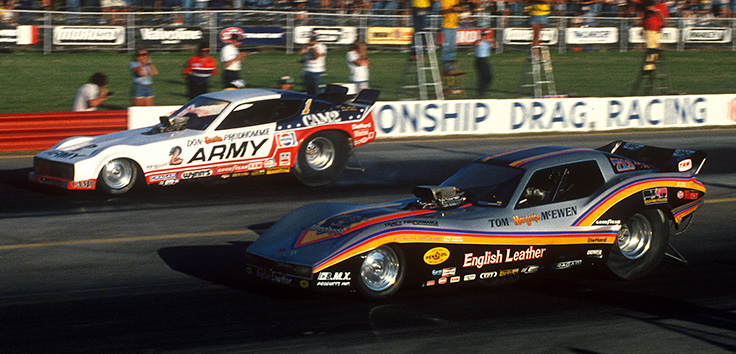
I mean, is there a more heartwarming moment in the sport’s history than this? You’ve got best friends and partners turned rivals in the final round of the year’s biggest race. In one lane, you have 27-time national event winner Don Prudhomme, en route to winning his fourth straight world championship, against Tom McEwen, who had just one win to his credit. But McEwen is on a mission, racing with a broken heart after the recent passing of his son Jamie, himself a big “Snake” fan. It was “win one for the Gipper," drag racing style, and McEwen did.
Twenty-two years ago, at the 50th anniversary NHRA U.S. Nationals, this race was fan-voted the No. 1 moment in Indy history, so it was a little stunning and disappointing for it to come in at No. 25. Maybe I didn’t do a good enough job in the brief explanation of each moment on the ballot.
NHRA announcer and Sportsman Racing Manager Jason Galvin, whose uncle, Pat, was part of McEwen’s crew, was naturally disappointed, too. Mike Rose had it eighth on his list. (Rose’s No. 1 pick was NHRA’s formation “because without it, there are no other moments.”)
My drag racing fandom was born and grew in the early- to mid-1970s, so Prudhomme and McEwen were my guys (the fact they also had Hot Wheels cars didn’t hurt), and just the human tragedy and drama of Jamie’s passing and of “Snake” — normally the sorest of losers (“If I can’t win, I hope no one wins”) — crawling under the body at the top end to cry with his pal is just so amazing to those of us who knew the pair. I also will never forget Prudhomme’s quote about the final, which was the basis for the Snake & Mongoose movie: “How good was I in the 1970s? I was so good that the one time I got beat, they made a whole movie about it.” Priceless.
2. Tony Schumacher’s "The Run"
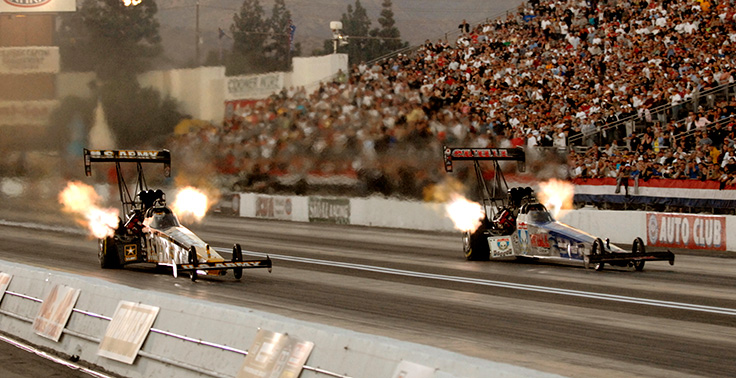
I can’t think of a more precise bit of race-car tuning than the final Top Fuel round of the 2006 season that won Tony Schumacher the championship and indelibly burned in our brains the television close-up of a crestfallen Doug Kalitta when Schumacher and tuner Alan Johnson pulled it off.
To recap briefly, Schumacher entered the Finals trailing Kalitta and needed to break the existing 4.437 national record and win the final to do it. The problem is, back then, you had to run within 1% of a record-breaking run as a “backup run” (a remnant from before timing systems became so accurate and dependable). In qualifying, Schumacher had posted a 4.458-second run, which could serve as the required 1% backup, but they had to run 4.436 or better, but not faster than 4.414, which would be too quick for the 4.458 to serve as the record backup. In drag racing’s equivalent of a walk-off home run, Johnson tuned Schumacher’s Army dragster right into that narrow .022-second window with a 4.428.
When I tell this story to people, I don’t try to tell them how scores of mechanical parts had to perform flawlessly, that the track grip and weather conditions had to be right, or that Schumacher had to keep it in the groove. I tell them to imagine dropping a golf ball off the top of a 50-story building and needing it to land in a shot glass.
I was there to see this one happen. No one in the place thought it was possible, except maybe AJ. Twenty years later, it’s still a fond memory.
3. Don Garlits' 5.63, 250-mph run
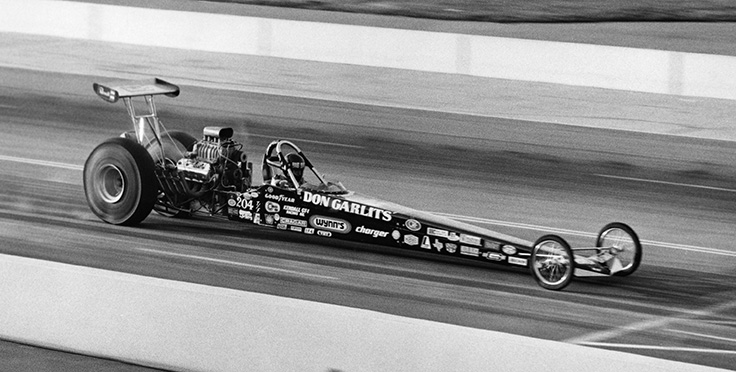
Outside of “The Run,” this may be the single most famous run in the sport’s history. At the time of the NHRA World Finals at Ontario Motor Speedway, October 1975, it was just a great run. Garlits had set the national record at 5.78 at the 1973 Supernationals in Ontario, and it was Gary Beck who ran the first 5.6-second time, a 5.69, during qualifying, and Garlits who followed Saturday with the 5.63 at 250.69 — the first 250-mph clocking in the sport’s history (he’d run 249.30 two months earlier) — that became the national record and the bonus point that helped him pass Beck for his first NHRA world championship.
But what gives the 5.63 its legendary status is not what happened that day, but what didn’t happen afterwards. The record was not bettered for nearly seven years — 2,470 days, or more than six years and nine months, from Oct. 12, 1975 until July 17, 1982 — until Mark Oswald broke it during the NHRA Summernationals with a 5.62 pass in the Candies & Hughes dragster. In the interest of fair reporting, Jeb Allen had actually run quicker than Garlits’ 5.63 more than a year before Oswald broke the record, recording a 5.62 March 12, 1981, during Thursday qualifying for that year’s Gatornationals, but was unable to back it up for a new record. Still …
4. Kenny Bernstein’s 300-mph run
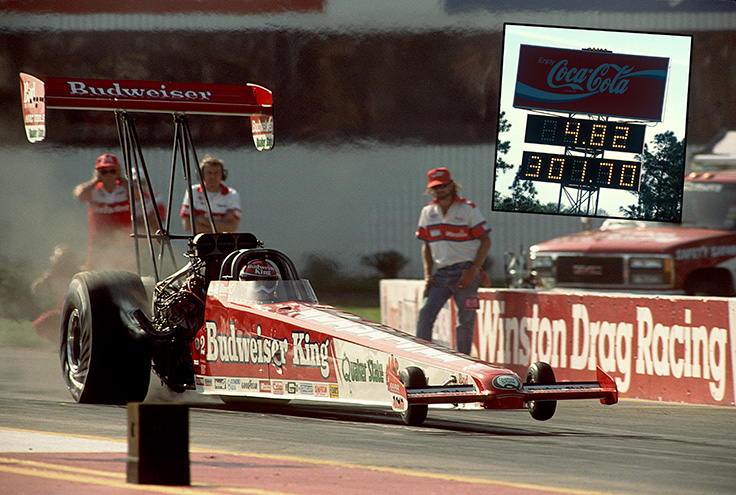
I think we’ve already covered this at the top of the column. The fact that it took 11 months for anyone else (Doug Herbert, at the 1993 Winternationals) to run 300 and the fact that it gave NHRA international exposure only adds to the marvelousness of the feat.
5. John Force’s first career win
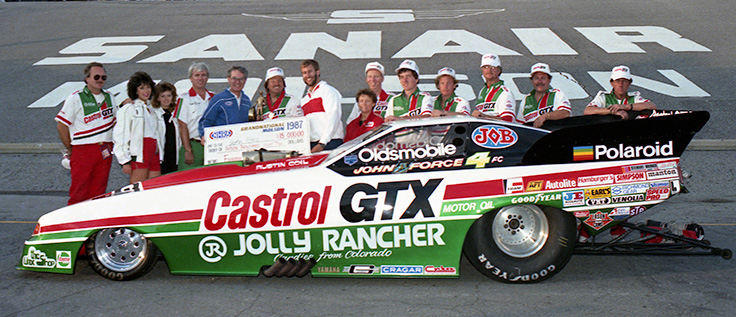
This is another sentimental favorite, mostly because I was there at the 1987 Le Grandnational outside of Montreal to witness it. I’d watched John Force struggle for years, first as a fan — I had that huge poster of Force’s Wendy’s ’79 Corvette on my bedroom wall (my girlfriend at the time worked at Leo’s Stereo, which was one of his sponsors, which is how I scored the poster) — then continued to watch him score runner-up after runner-up after joining NHRA in 1982. It seemed like the guy might never win.
Then, when he finally did, it was on a rain-delayed Monday after most of the TV crew had left, so there were scant few around to congratulate him. I’m sure it’s not exactly how he dreamed of it happening, but like Rose’s comment about the founding of NHRA starting everything, the same could be said for this win. Oh, sure, he’d have won at some point, but this one proved to him that he really could.
6. Don Garlits' 1971 Winternationals
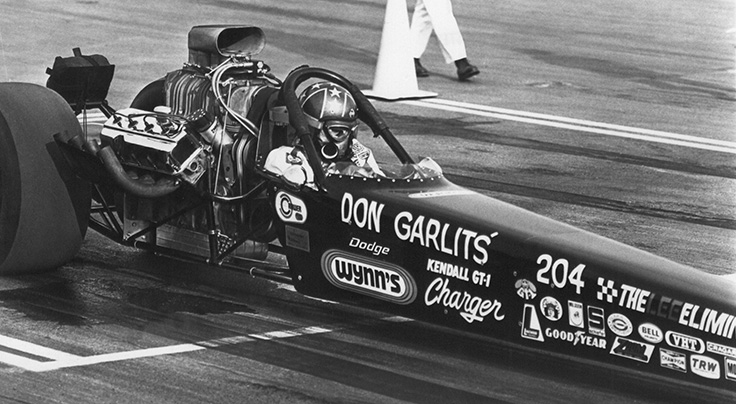
This is such a seminal moment in Top Fuel’s history, and the only reason it’s sixth for me is because of my sentimental attachment to the first five. I was still a very young fan at the time, and although my first trip to the drags came after this, there were still quite a few front-engine cars at the drags. I was too young to understand the significance then, and I liked the front-engine dragsters from a coolness perspective, but as I came to learn the story and have seen what it’s done for the sport, you can see the appeal.
7. Shirley Muldowney’s first Top Fuel win
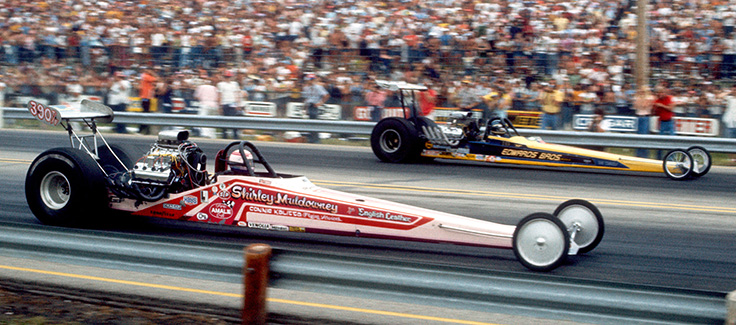
Like Force’s first win, Muldowney was bound to win one sometime. She was too determined not to. After two runner-ups in 1975 — to Marvin Graham at the Springnationals and to Don Garlits in Indy (“the lady dragster driver is in the final,” Garlits almost dismissively clucked at the top end after both won their semifinals) — she made history at the Springnationals the following year.
It’s one thing to have a woman competing against you in your class, but a whole other thing when she wins the race. The boys were on notice, and the world began paying attention.
8. Formation of the NHRA
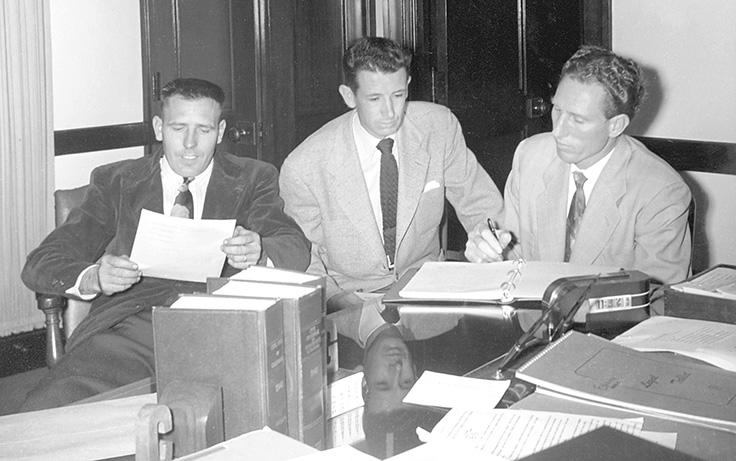
What would have happened had Wally Parks not publicly called for the formation of a national association of hot rodders in 1951? Who knows? Surely another someone — Jim Tice or Larry Carrier, maybe — would have eventually begun organizing drag races, but Parks never set out to stage drag races. It kills me to read “Wally Parks formed the NHRA to get street racers onto the dragstrip.” That was the byproduct. At first, he just wanted to improve the reputation of the sport of hot rodding, which meant the customization and performance enhancement of cars. All of the racing stuff came later as he “brought organization to chaos” and helped those who didn’t live near dry lakes find a safe place to run their cars.
9. Don Garlits’ 1984 Indy win
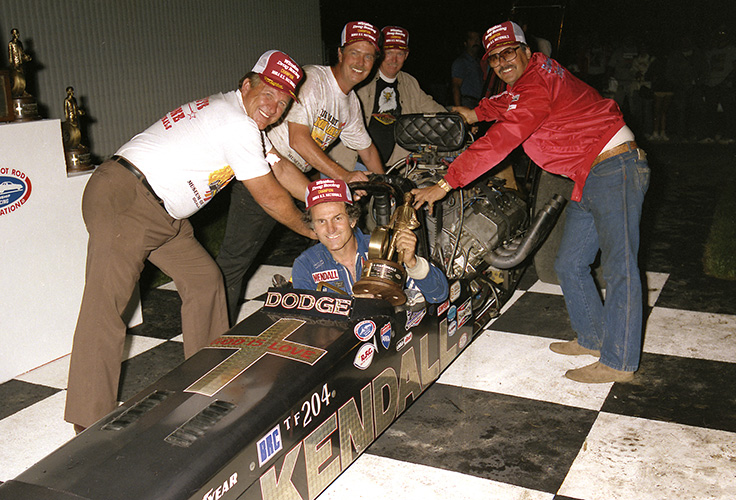
I guess you had to be there in 1984 to truly understand the gravity of this moment. It’s not just that “Big” won Indy again — for the sixth time and for the first time in six years — but his victory propped up what was a flagging Top Fuel class and very likely saved it from extinction. The previous year, IHRA had ditched the class entirely. Car counts at NHRA events were already low — sometimes eight to 10 cars for an eight-car field. Doug Kerhulas had been injured earlier that summer at the Springnationals, and weeks later, the sport was devastated by Shirley Muldowney’s horrible accident in Montreal. Only 12 cars showed up for the 16-car field at the Summernationals.
But when Garlits and his team of “dinosaurs" (his word) not only showed up and won Indy, the world changed. The Top Fuel Classic bonus event was created, and Charlie Allen staged the biggest Top Fuel-centric match race weeks later in Phoenix, which Garlits won, as he did the World Finals after that. Fan and media interest soared, as did teams jumping into the fray. Top Fuel was back!
10. Pat Austin’s Topeka double
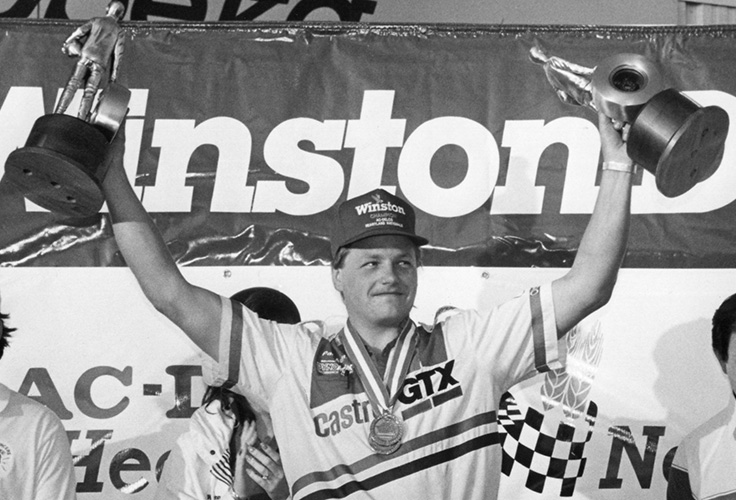
Today, a driver winning in two classes at the same event is, while not a regular feat, no longer a huge deal. It has been done 45 times, almost all of them in dual Sportsman-racing classes, but the first was a shocker, not only in that it finally happened, but that Pat Austin did it in Top Fuel and Top Alcohol Funny Car.
I’ll never get tired of this story, especially because of my personal connection to the tale. As you can read in this column, Austin made his Top Fuel debut in Indy; it was spectacular, and he reached the final round. He won the Top Alcohol Funny Car final, then suited up for the Top Fuel money run, but backfired the blower on the burnout, giving Kenny Bernstein a bye run to victory. That Bernstein smoked the tires on his solo was salt in Austin’s wounds.
I was pretty tight with Austin at the time, if for no other reason than I’d interviewed him dozens of times for National Dragster stories about his Top Alcohol Funny Car wins. We had an easygoing relationship, so as he and I walked back to his pit after the disappointing Top Fuel loss, he was frustrated and mad at himself for botching the burnout and told me, "I guarantee that I will not only win with the Top Fueler before the season is over, but I'll win with both cars at the same race." Great quote, I thought, and used it in the next issue, only to find out that Pat didn’t think I still had my reporter hat on. He was aghast and worried about the blowback from sounding too cocky. Two races later, he doubled in Topeka. Problem solved, and I ended up back on his Christmas card list.
OK, race fans, so there you have it, my final debrief on the Top 75 Moments project. I hoped you enjoyed the program and remembered and relived some great performances from the sport’s amazing history.
Phil Burgess can be reached at pburgess@nhra.com
Hundreds of more articles like this can be found in the DRAGSTER INSIDER COLUMN ARCHIVE
Or try the Random Dragster Insider story generator