

-
From Dearborn to the dragstrip: Ford Racing's story began 125 years ago today
-
Behind the Scenes with the winners of the 2026 NAPA Auto Parts Midwest Nationals
-
Weekend Rewind: 2026 NAPA Auto Parts NHRA Midwest Nationals
-
Saturday in St. Louis: NAPA Auto Parts NHRA Midwest Nationals photo gallery
-
Could St. Louis bring out the best in Erica Enders once again?
-
-
Cameron Ferre: Still chasing Top Fuel greatness, just on his own terms
-
Ron Capps thinking big at NAPA Auto Parts NHRA Midwest Nationals
-
Top Fuel’s Shawn Langdon looking for fourth straight win of 2026
-
Behind the Scenes with the winners of the 2026 NHRA Nationals at The Rock
-
Weekend Rewind: The inaugural NHRA Nationals at the Rock
-
Five Things We Learned in Rockingham
-
New venues like Rockingham bring excitement for old pro Ron Capps
-
That was then, this is now: The Winston Invitational at Rockingham
-
After a near-miss in Michigan, Ingwersen and crew are more inspired than ever
-
Jordan Vandergriff relishes first opportunity to race at Rockingham Dragway
- ad
-
Behind the Scenes with the winners of the 2026 Dodge NHRA Great Lakes Nationals
-
Weekend Rewind: 2026 Dodge NHRA Great Lakes Nationals
-
Five things we learned from the Dodge NHRA Great Lakes Nationals presented by Mopar
-
Vandergriff and crew took aim at No. 1 in challenging Michigan conditions
-
Friday Photo Gallery- NHRA makes a monumental return to Michigan
-
Inaugural Dodge and NHRA Tour de Michigan launches historic race weekend
-
Reigning world champ Dallas Glenn gears up for first Countdown race
-
Stewart, Hagan, Pruett reveal new Dodge Charger Super Bee Purple Haze liveries
-
Behind the Scenes with the winners of the 2026 Cornwell Tools NHRA U.S. Nationals
-
Weekend Rewind: 2026 Cornwell Quality Tools NHRA U.S. Nationals
- ad
-
Malcolm Phillips makes his Pro Stock Motorcycle return at Indy
-
No canopy, no problem for Justin Ashley and his crew chiefs
-
Prock Indy three-peat would make U.S. Nationals Funny Car history
-
Howey returns to Indy with his eyes on a Top 10 berth
-
Nataas looks to add to previous Indy success story
From Dearborn to the dragstrip: Ford Racing's story began 125 years ago today
By Kelsey Quartuccio, for Ford Motor Company
Ford’s racing story began 125 years ago today, on October 10, 1901, with a result measured at the finish line. In 1901, Henry Ford drove Sweepstakes to an upset victory over Alexander Winton in a 10-lap race around a horse track. The win demonstrated Ford’s engineering instincts, attracted crucial financial backing and helped set the Ford Motor Company in motion. Competition was part of the company’s identity before the company itself existed.
That founding spirit has endured through every era of Ford Racing: build something ambitious, put it in the most demanding arena available and let performance establish its credibility. Racing creates an unforgiving cycle of innovation. Ideas are tested under pressure, weaknesses are exposed, and lessons return to the engineers tasked with making the next Ford faster, stronger and better.
Few forms of motorsport embody that philosophy as completely as drag racing. The objective is elemental—reach the finish line first—but accomplishing it requires mastery of horsepower, traction, weight, aerodynamics and human reaction. The quarter-mile offers no place for an unproven claim to hide. The clocks deliver the verdict in thousandths of a second.
For most of the National Hot Rod Association’s 75 years, Ford has treated the drag strip as a compressed laboratory, where a launch, gear change or thermal problem becomes a judgment measured in seconds. As Ford Racing marks 125 years since that first victory, the quarter-mile offers a clear view of the company’s racing philosophy: build, race, learn, repeat. In 2025, Time named Ford America’s most iconic company.
Ford’s drag-racing record cannot be reduced to one dynasty or one famous engine. It stretches from dealer-prepared sedans to factory engineering teams, from local heroes to factory-backed champions, and from the Thunderbolt and Cobra Jet to the Mustang Dark Horse Funny Car. The pivotal moments came when Ford connected engineering, parts, dealers and racers into a system.
Ford Learns to Launch
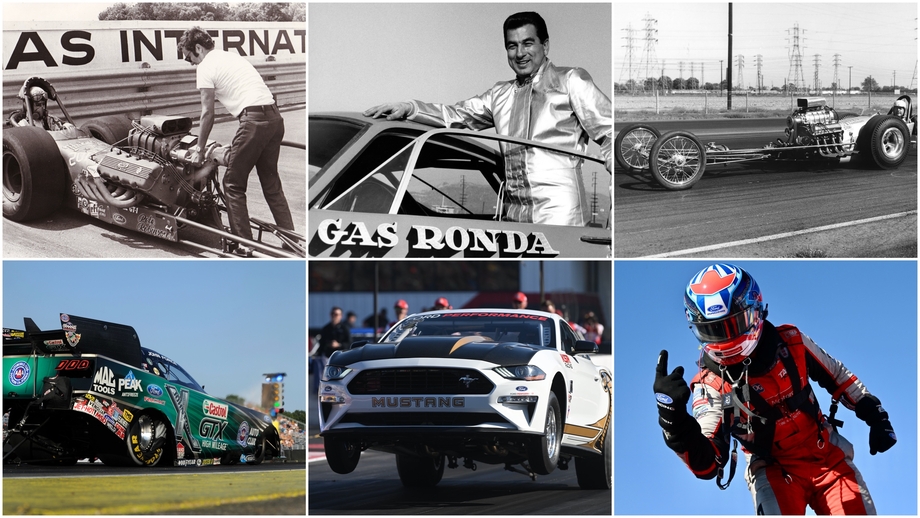
By the early 1960s, Detroit’s horsepower war had moved to the staging lanes. Ford answered with the Ford Drag Team, formed in 1962 around racers including Dick Brannan, Gas Ronda, Les Ritchey, Phil Bonner, Mickey Thompson, Ed Martin Don Prudhomme, Pete Robinson, Ed Pink, Connie Kalitta, and dozens of others.
The roster mattered, but the structure mattered more. Ford was creating a feedback loop among Dearborn, specialist builders, dealers and the people who had to make the hardware live at full throttle.
In 1964, Dearborn Steel Tubing built 100 Fairlane Thunderbolts around the 427 FE. The first 11 team cars were invoiced to participating dealers for one dollar, with the expectation that they would race and report what they learned. The Thunderbolt delivered Ford an NHRA Super Stock championship and showed what organized factory support could accomplish.
One earlier Ford component would become even more universal than the Thunderbolt itself. Introduced for 1957-model-year vehicles, the Ford 9-inch rear axle combined strength, a removable center section and easy gear-ratio changes. Production ended in 1986, but drag racers never stopped using it. It remains one of the most enduring racing components ever created: a production part so well suited to drag racing that the aftermarket refused to let it die.
A Dealer Idea Changes the Factory
Bob Tasca Sr. understood that racing could expose a problem, provide a solution and create demand in a single weekend. At his Rhode Island dealership, he combined Ford components into a potent 428 package and pressed Dearborn to build it. Ford responded with the 1968 Cobra Jet Mustang, a factory-prepared drag car that carried dealer ingenuity onto one of NHRA’s biggest stages.
At the 1968 Winternationals, a Ford-backed group that included Al Joniec, Gas Ronda, Hubert Platt and Randy Ritchey arrived with the new cars. The special Mustangs shed radios, sound deadener, undercoating and heaters. Their 428 engines were advertised at 335 horsepower but produced considerably more. Joniec defeated Platt in an all-Cobra Jet Super Stock final with an 11.49-second run at more than 120 mph. The formula was complete: a dealer identified the opportunity, Ford engineered and produced the car, and racers proved it in public.
Tasca Sr. is closely associated with the phrase “Win on Sunday, sell on Monday.” His grandson, Bob Tasca III, describes the modern version as emotional marketing—a connection that cannot be measured like a digital advertisement.
“Winning, losing, competing, fighting, performance, engineering, excellence—all of that is rolled up into racing,” Tasca III said. “When you can highlight elite engineering at the highest level of performance and go out and win, you help build the brand.”
Glidden Builds a Ford Dynasty
When NHRA introduced Pro Stock in 1970, the class was conceived as a home for factory hot rods. Don Nicholson earned Ford’s first Pro Stock national-event victory in 1971 and its first class championship in 1977. Bob Glidden then made the Blue Oval the category’s defining rival.
A former Ford dealership mechanic, Glidden won his first Pro Stock event at the 1973 U.S. Nationals. He finished his career with 85 victories, 10 championships, 102 No. 1 qualifiers and nine U.S. Nationals wins. In 1978, he won nine consecutive national events across the calendar year and qualified No. 1 at 23 straight races. After a violent crash in 1986, he returned within a month, won six of the final seven events and claimed the title.
Glidden’s program made the case for continuity: the right racer, backed over time and trusted to execute, could become a factory’s competitive identity. He later reduced that relentless approach to one sentence: “If I wanted to go racing, I had to win so I could afford it. It’s all we knew.”
Force Carries Mustang into the Modern Era
The next transformation came through aerodynamics, data and scale. Kenny Bernstein and crew chief Dale Armstrong used Ford’s wind tunnel to develop the Tempo Funny Car, bringing rounded wheel openings, enclosed side windows and a belly pan into a measured aerodynamic program. Bernstein recorded the first 260-mph Funny Car pass in 1984 and won the 1985 championship.
John Force returned to Ford in 1997 and raced its cars through 2014. In Ford Mustangs, he won 10 of his 16 championships and 81 of his first 149 national-event victories. Tony Pedregon added the 2003 title and Robert Hight the 2009 championship, giving John Force Racing 12 driver titles during its Ford era. Ford and the team also developed the BOSS 500 nitro engine.
The same era delivered a harder lesson. After Eric Medlen died following a testing accident in 2007, John Force Racing created the Eric Medlen Project with Ford, the SFI Foundation, Goodyear and other specialists. The work contributed to the first major Funny Car chassis redesign in nearly 30 years and helped focus the industry on crash dynamics, tire behavior and driver protection. Drag racing’s technical ledger is not measured only in elapsed time; safety knowledge may be its most important return.
“We worked with Ford engineers to build better, safer stuff—and that’s what it’s all about,” Force said at the time.
Built to Win: Tasca, Prock and Ford
Bob Tasca III has spent years racing Ford Funny Cars. Now he has taken on a different role: carrying Ford’s drag-racing torch into a new generation of professional competition.
Tasca stepped out of the driver’s seat to bring Austin Prock and championship-winning crew chief Jimmy Prock into Tasca Racing. His goal was to build a team capable of winning a championship for Ford. The move put a proven driver at the wheel and brought the Prock family’s experience together with Tasca’s commitment and Ford’s factory support.
The partnership faced an early test in 2026. The team failed to qualify at the season-opening race in Gainesville, and the new Funny Car struggled to make consistent full runs. The combination required fresh solutions, from clutch setup and engine tune to chassis configuration. Tasca said the team kept adjusting to what the car was telling them—and never stopped believing they could win.
That persistence paid off when Austin Prock and Tasca Racing captured the NHRA Potomac Nationals in Maryland. For Tasca, the victory validated his decision to leave the cockpit and concentrate on building a championship team with Prock behind the wheel.
The alliance brings together three family legacies: Tasca’s, the Procks’ and Ford’s. Tasca believes the people and chemistry behind the program give it the foundation to achieve more together than they could separately. The championship remains the goal; the Maryland win showed the group was moving in the right direction.
“Parts and pieces don’t win anything—people do.”—Bob Tasca III
The Cobra Jet Goes Electric
The most direct link between Tasca’s family history and Ford’s future still carries the Cobra Jet name. Ford revived the badge in 2008 as a turnkey sportsman drag car and also used it for a series of electric demonstrators. The Cobra Jet 1400 ran 8.128 seconds at 171.97 mph in 2021. The Super Cobra Jet 1800 lowered the full-bodied electric quarter-mile record to 7.623 seconds at 182.16 mph in 2024.
The Mustang Cobra Jet 2200 pushed the idea into the sixes at zMAX Dragway in 2026, running 6.76 seconds at 222 mph with approximately 2,200 horsepower at the rear wheels. It became the quickest and fastest electric car in the quarter-mile. Ford engineers paired two electric motors with a five-speed clutchless transmission and a patented reverse-acting centrifugal clutch. The clutch manages the motors’ immediate torque at launch, allowing controlled slip before locking as speed rises. Four batteries help with weight distribution, while the car is more than 1,000 pounds lighter than the 1800.
As Cobra Jet 2200 program supervisor Nick Kuhajda put it, “The timeslip tells one part of the story. What we learn from it tells the rest.”
Allegrucci Clinches the Factory Stock Showdown Championship in a Supercharged V-8 Mustang Cobra Jet
Jonathan Allegrucci closed a championship season in style Sunday, winning the Flexjet NHRA Factory Stock Showdown at World Wide Technology Raceway and securing the 2026 world title in a Ford Mustang Cobra Jet. He became the first racer in any class to clinch a championship during the 2026 season—and the first recipient of NHRA’s special diamond 75th anniversary championship.
The St. Louis victory capped a campaign built on speed, consistency and resilience. Allegrucci opened the season with the No. 1 qualifying position in Gainesville, but an early second-round exit kept him from starting with a win. He and his team quickly turned that qualifying pace into race-day results.
Allegrucci earned his first victory of the season at the NHRA Four-Wide Nationals in Charlotte, then added wins in Chicago and Bristol. Runner-up finishes in Norwalk and at the Cornwell Quality Tools NHRA U.S. Nationals strengthened his points lead and positioned him to contend for the championship.
Three victories and two runner-up finishes reflected the balance required to claim a championship: quick qualifying performances, strong race-day execution and the ability to recover when results fell short. His victory in St. Louis turned a season of sustained contention into a defining achievement in Factory Stock Showdown.
From Sweepstakes to NHRA Championships
Ford’s drag-racing history is full of legendary names, but its deepest continuity is structural. Dearborn engineers, specialist fabricators, dealers, race teams and private competitors have repeatedly handed problems back and forth until the car moved faster. Factory support created engines, aerodynamic development, safety research and turnkey competition cars. Racers supplied urgency, invention and an honesty no boardroom test can reproduce: either the win light turns on, or it does not.
The cars changed from Fairlanes to Mustangs, from carburetors to electronic controls, from gasoline to nitromethane to batteries and blown V-8 engines. The mission did not: make the power usable, keep the driver safe, learn before the next round—and get to the finish line first.